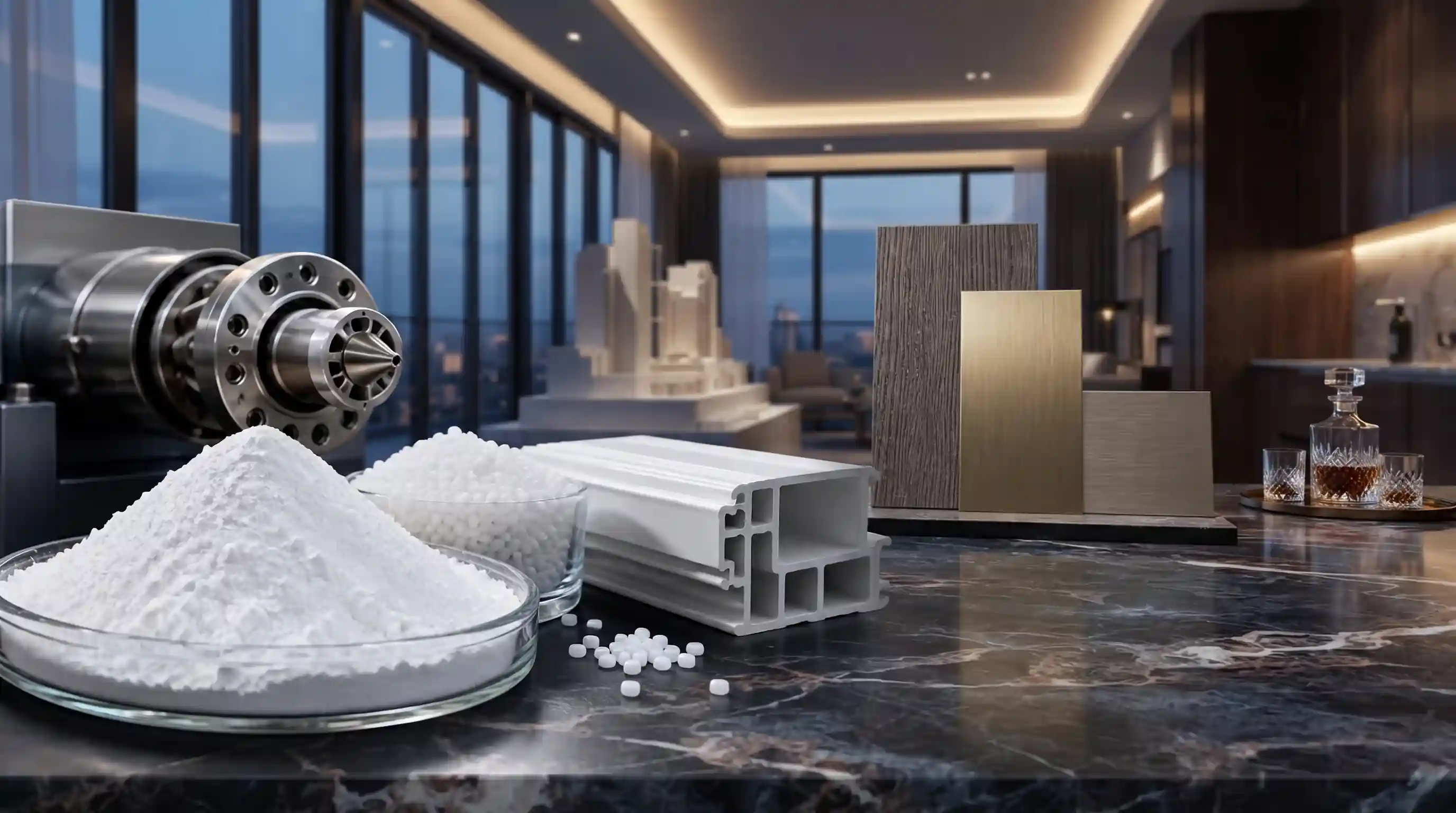
Examining the Impact of Coated Calcium Carbonate on the Shrinkage of Injection-Molded Parts
Introduction to the Importance of Reducing Shrinkage in Polymeric Injection-Molded Parts
The plastic injection molding process is one of the most common methods for producing polymer parts with complex geometries. However, a major challenge for engineers and manufacturers in this industry is the phenomenon of shrinkage, which occurs after the part cools inside the mold. Shrinkage can lead to warping, dimensional changes, part misalignment, and a reduction in the final product's quality. For this reason, utilizing efficient mineral additives to control and minimize these dimensional changes is of profound importance.
Among fillers and mechanical property modifiers, the use of coated calcium carbonate as an advanced engineering solution has attracted the attention of many plastic industry professionals. With its specific characteristics, this material can noticeably improve the dimensional stability of injection-molded parts. To better understand the working mechanism of this additive, it is necessary to know how it combines with the polymer matrix and what role it plays in modifying the thermal and melt flow behavior.
One of the key topics in particle coating is the type of fatty acid used, which has a direct impact on the uniform distribution of particles. In this regard, reading the article Examining the Impact of Stearic Acid in Coated Calcium Carbonate Coating provides complementary and valuable information for researchers and practitioners in the field of polymer compounds, significantly aiding the optimization process.
Kani Sang Amiran Project, by producing and supplying various high-quality minerals, has prepared this product for various industrial applications. The careful selection of particle size based on the 450 to 3500 mesh range plays a key role in controlling shrinkage, which will be discussed in detail in the subsequent chapters of this article.
The Role of Coated Calcium Carbonate in Reducing Dimensional Shrinkage
The shrinkage of injection-molded parts is mainly caused by the volume reduction of the molten polymer during cooling and crystallization. When pure polymer cools, its molecular chains move closer together, reducing the overall volume of the part. The addition of mineral fillers such as coated calcium carbonate creates a rigid network within the polymer matrix that acts as a strong skeleton, preventing severe volumetric changes.
Coating the particles with fatty acids improves compatibility between the hydrophobic mineral particle and the polymer matrix. This improved compatibility results in a homogeneous distribution of particles throughout the injection-molded part. As a result, residual stresses and anisotropic shrinkage—which are common problems in plastic injection molding—are significantly reduced, and the final part achieves much better dimensional stability.
This material is chosen for producing various compounds, polymer granules, profiles, cables, flooring, and PVC parts due to its unique characteristics. By occupying the space between polymer chains, this mineral filler reduces the total amount of shrinking polymer and also improves the linear thermal expansion coefficient of the part, ensuring dimensional stability across thermal cycles.
To correctly and systematically select this material based on your industrial needs, a careful examination of the technical specifications and particle standards is of high importance. This helps produce injection-molded parts with the lowest amount of warping and the highest dimensional accuracy.

Examining the Mesh Range and Its Impact on Polymer Flow Behavior and Shrinkage
The particle size of mineral fillers is one of the most important parameters directly affecting the physical and mechanical properties of injection-molded parts. This product is supplied in a mesh range of 450 to 3500, with each mesh suitable for specific applications in compounding industries, PVC part manufacturing, and polymer granules. Choosing the appropriate mesh can maintain melt flowability inside the mold while simultaneously improving dimensional stability.
In this regard, a detailed study of the article Examining Mesh Grading Standards in Various Types of Coated Calcium Carbonate helps industrialists gain a better understanding of particle size distribution and choose the most suitable option for their production lines. Finer particles with high meshes (such as 3500) create a larger contact area with the polymer, which is very effective in improving mechanical properties and reducing local shrinkage.
On the other hand, using lower meshes is applicable in cases where the goal is to increase production efficiency and reduce melt viscosity. The balance between the filler content and its mesh size allows mold designers to control the injection process with greater precision and prevent appearance and dimensional defects.
Mineral producers at the Kani Sang Amiran Project, by carefully grading and processing their products, have made it possible to achieve desired technical specifications for various industries, including cable manufacturing, profiles, and polymer flooring, to achieve the highest shrinkage quality.
Mechanism of Action of Fatty Acid Coating on Improving Mechanical and Dimensional Properties
Due to its hydrophilic nature, regular calcium carbonate does not distribute well in hydrophobic polymer matrices and usually agglomerates. These agglomerates create weak points in the injection-molded part that can be the source of heterogeneous shrinkage and premature failure. The coating process (surface coating) completely solves this problem and makes the particles compatible.
The coating layer reduces the surface energy of the particles and minimizes internal friction between the particles and the polymer chains. This feature helps better melt flowability inside the runners and mold cavities. When the melt fills with greater ease, fewer internal stresses are created in the part, resulting in more uniform post-cooling shrinkage.
In addition to dimensional stability, this surface coating helps better stress transfer from the soft matrix to the rigid particles, ultimately leading to improved impact resistance, tensile strength, and overall durability of polymer parts. These features are vital for parts subjected to constant mechanical stresses.
Engineering investigations show that the resistance of polymer products to environmental factors and mechanical stresses increases significantly with the presence of this additive. In this regard, reading the applied article How Coated Calcium Carbonate Increases the Resistance of Polymer Products? provides deep scientific perspectives on the reinforcing mechanisms of this material.

Applications in Compounds, Granules, and Specialized PVC Parts
Polymer products are used today in a wide range of industries, including construction, automotive, electronics, and packaging. Producing high-quality parts in these industries requires the use of engineered compounds and granules. Coated calcium carbonate is considered one of the main components in modern polymer compound formulations, playing a key role in reducing shrinkage due to its outstanding features.
In the production of door and window profiles, pipes and fittings, as well as rigid and flexible PVC parts, controlling shrinkage is crucial for maintaining dimensional tolerances. The presence of this mineral material with a suitable mesh in the PVC formulation, in addition to lowering the final product cost, improves flexural modulus, reduces thermal deformation, and minimizes longitudinal and transverse shrinkage.
Also, in the production of power and telecommunication cables, the dimensional stability of the insulation and jacketing is vital to prevent cracking or thickness changes over time. Using this coated material in the cable manufacturing industry greatly helps improve the electrical and mechanical properties of the insulation layer.
Polymer flooring and decorative tiles are other important applications of this product, which heavily depend on this mineral additive due to the need for surface smoothness, warpage resistance, and dimensional stability against ambient temperature changes.
Optimizing Plastic Injection Parameters with the Presence of Mineral Additives
Adding mineral materials such as coated calcium carbonate to the polymer matrix alters the thermal and rheological behavior of the compound. Therefore, to achieve the lowest shrinkage and best quality in injection-molded parts, the plastic injection machine parameters—including temperature, injection pressure, holding pressure, and cooling speed—need to be precisely adjusted and optimized.
The presence of coated particles increases the cooling rate of the part inside the mold due to the improved relative thermal conductivity of the compound. This reduces the cycle time and increases productivity, but on the other hand, it requires precise adjustment of the holding time and pressure to prevent internal shrinkage cavities (sink marks).
Mold temperature adjustment is another key factor. A uniform mold temperature, combined with a homogeneous distribution of filler particles, prevents unbalanced shrinkage and part warpage. Production line operators, having a precise understanding of the properties of the compound containing this material, can apply the best settings for complex molds.
Given the variety of manufactured products in the Kani Sang Amiran Project, the precise selection of mesh and the blending percentage of this additive, along with modern injection machinery settings, will guarantee the production of parts with precise dimensions, a smooth surface, and ideal mechanical properties.

Economic and Qualitative Benefits of Using Coated Mineral Fillers
In addition to the technical benefits mentioned regarding the control and reduction of shrinkage in injection-molded parts, using coated calcium carbonate offers very high economic justification for manufacturing units. Given the relatively high price of engineering polymers and thermoplastics, replacing a portion of the polymer resin with this high-quality mineral material directly reduces raw material costs without causing a noticeable drop in final quality.
From a qualitative perspective, parts produced with an optimal percentage of these compounds show better dimensional stability during storage and actual use. This stability means reduced production waste, lower customer return rates, and increased overall productivity of plastic injection lines.
Improving surface hardness, increasing elasticity modulus, and improving paintability and printability properties in polymer parts are among the other side benefits of this additive. These features ensure that manufactured products have a more professional appearance and more reliable performance across various industries.
Industrial manufacturers are constantly looking for ways to increase quality and reduce costs. The intelligent use of standard mineral products supplied by the Kani Sang Amiran Project is a reliable way to achieve these commercial and technical goals.
Conclusion and Future Outlook in Compounding and Injection Industries
The issue of reducing shrinkage in polymeric injection-molded parts is one of the core pillars of manufacturing engineering in the plastics industry. As examined, using coated calcium carbonate as an engineered additive with a suitable mesh range (450 to 3500) is an efficient solution to curb dimensional changes, improve thermal stability, and enhance the mechanical properties of parts.
Surface coating of particles with fatty acids plays a vital role in resolving agglomeration issues and creating excellent compatibility between the mineral phase and the polymer matrix. This structural harmony leads to uniform stress distribution, reduced directional shrinkage, and ultimately the production of parts with the highest dimensional accuracy in industries such as compounding, profile manufacturing, cable, flooring, and PVC parts.
With the advancement of mineral manufacturing technologies and the optimization of coating processes, the role of such additives in advanced polymer industries is expected to become even more prominent. Precise mesh selection and adherence to formulation principles by industrialists are the keys to success in maximizing these potentials.
The Kani Sang Amiran Project collection, by offering standard and specialized products, is always ready to cooperate with engineers, manufacturers, and active players in the polymer industry to guarantee the quality and durability of final products by supplying high-quality raw materials.

| Question |
Answer |
| What is coated calcium carbonate? |
It is a type of processed calcium carbonate whose particle surface is coated with fatty acids (such as stearic acid) to achieve better compatibility with polymers. |
| How does this material reduce shrinkage in injection-molded parts? |
By creating a rigid network in the polymer matrix, occupying empty space, and improving uniform distribution, it prevents severe volumetric changes. |
| What is the mesh range of this product? |
This product is supplied in a mesh range of 450 to 3500 based on the needs of various industries. |
| What are the main applications of this additive? |
Compounds, polymer granules, profiles, cables, flooring, and PVC parts. |
| Why is surface coating of particles important? |
The surface coating prevents particle agglomeration and greatly improves melt flowability and compatibility with the polymer. |
| Does this material affect the final production cost? |
Yes, replacing a portion of expensive resins with this mineral filler significantly reduces production costs. |
| What is the effect of a high mesh (e.g., 3500) on the part? |
Higher meshes create a larger contact area and are very effective in improving mechanical properties and reducing local shrinkage. |
| How can injection parameters be optimized with this material? |
By precisely adjusting the temperature, injection pressure, holding pressure, and cooling speed to match the thermal behavior of the new compound. |
| Is this product used in the cable manufacturing industry? |
Yes, it is used to improve the dimensional stability, electrical properties, and mechanical properties of cable insulation and sheathing. |
| Where can this product be procured? |
The Kani Sang Amiran Project is a producer and supplier of various mineral materials for the polymer industries. |
Specialized Reference for Minerals and Polymer Compounds - Kani Sang Amiran Project.
:: برچسبها:
Coated Calcium Carbonate ,
Examining the Impact of Coated Calcium Carbonate on the Shrinkage of Injection-Molded Parts ,
:: بازدید از این مطلب : 2
|
امتیاز مطلب : 0
|
تعداد امتیازدهندگان : 0
|
مجموع امتیاز : 0


 عضو شوید
 عضویت سریع
 آمار مطالب
 آمار بازدید


