How to Prevent Red Iron Oxide (Ochre) from Caking?
Introduction to the Importance of Preventing Red Iron Oxide Caking
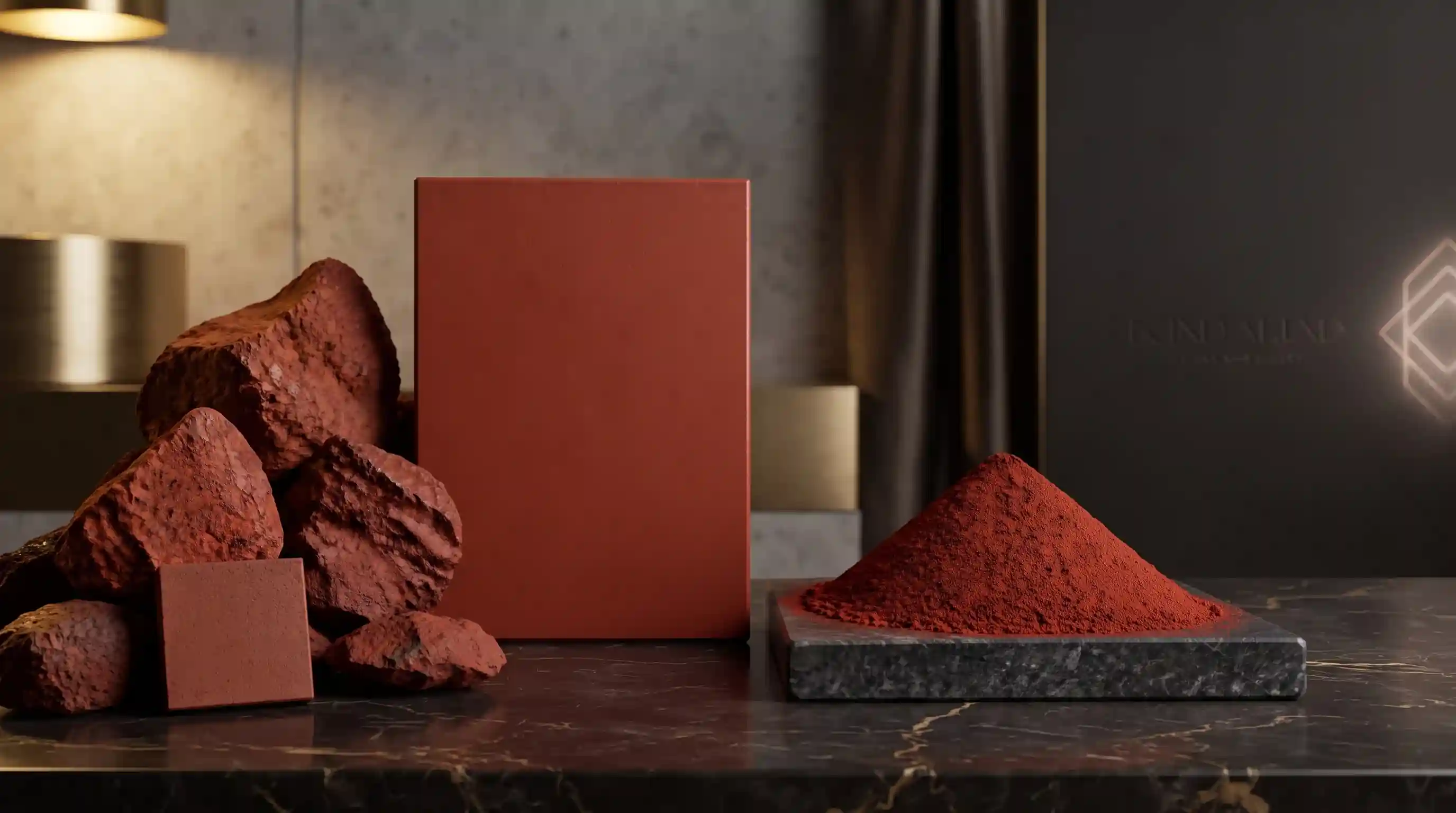
The mineral red iron oxide (ochre) is one of the most vital and widely used mineral pigments in various industries, known for its beautiful color. This high-quality mineral plays a key role in the production of diverse industrial products. However, one of the biggest challenges faced by manufacturers and producers is the phenomenon of caking in this powdery material. Caking can disrupt the production process and affect the final quality of the product.
In this specialized article from the Kani Sang Amiran project, we intend to thoroughly examine the causes behind the caking of this mineral pigment and provide scientific and practical solutions to prevent it. Understanding the environmental and physical factors affecting powders is an important step toward improving production efficiency. To learn more about other similar minerals, reading the article Introduction to the Features of Industrial Limonite Oxide (Gole Mash) is also recommended, as it provides useful information.
Controlling moisture, temperature, and storage conditions are among the most important factors that prevent fine powder particles from sticking together. Due to their extremely high specific surface area, micronized powders have a strong tendency to absorb ambient moisture. This moisture absorption ultimately leads to the formation of hard masses, or cakes, which are time-consuming and costly to break down and re-grind.
Mineral producers always strive to minimize the occurrence of these problems by optimizing packaging and providing precise storage guidelines. Adhering to industrial storage principles not only prevents raw material waste but also guarantees the final quality of products such as cement and coatings.
In the following sections, we will take a closer look at the physical specifications of this material, particularly its particle size and mesh range, to determine why micronized powders are more prone to caking than other materials and how this challenge can be overcome.
Understanding the Technical Specifications and Mesh Range of Red Iron Oxide (Ochre)
To better understand the powder behavior of red iron oxide (ochre), it is essential to examine its physical specifications, especially its particle size distribution. This product is produced and supplied with a mesh range of 450 to 1500 mesh, indicating its fine particle size and high micronization quality. Particles of this size are extremely fine, which is why they find wide applications in various industries.
A very fine particle size distribution (mesh range of 450–1500 mesh) means an increase in the specific surface area of the particles. The finer the particles, the higher their surface energy and the greater their tendency to absorb atmospheric moisture and form inter-particle bonds. This physical phenomenon is the main reason these types of powders cake when exposed to unfavorable environmental conditions.
Furthermore, in other industrial processes such as adding minerals to polymers, powder behavior is of similar importance. For example, in examining the physical properties of powders, the article How Coated Calcium Carbonate Helps Polymer Thermal Stability? offers fascinating points regarding the importance of particle surface area and modification, providing a better understanding of materials science.
The main applications of this mineral include its use as a pigment, coating, cement, and ceramic products. In each of these applications, powder uniformity and the absence of caking are of vital importance. If particles enter the cement or ceramic production line as agglomerated masses, the color distribution and mechanical properties of the final product will be flawed.
Therefore, a thorough understanding of the technical specifications and particle size distribution of this product is a primary prerequisite for designing proper storage, handling, and processing systems to prevent problems caused by caking.
The Role of Moisture and Environmental Factors in Mineral Powder Caking
Environmental moisture is considered one of the most destructive factors in the storage of powdery and micronized materials. When red iron oxide (ochre) is stored in humid warehouses or exposed to severe temperature fluctuations, the moisture present in the air settles on the surface of the fine particles of 450 to 1500 mesh, forming a thin layer of water. This moisture layer creates capillary bridges between the particles, and upon evaporation, forms strong solid bonds resulting in caking.
To prevent this phenomenon, precise control of the warehouse relative humidity is of high importance. Warehouses must be adequately ventilated, and powders should not be placed directly on concrete floors or in contact with cold walls. Using wooden or plastic pallets to keep bags off the ground is an essential standard in mineral storage.
In addition to moisture, temperature acts as a catalyst in surface reactions and moisture absorption. Diurnal temperature fluctuations can cause moisture condensation inside the packaging. For this reason, maintaining a stable temperature in warehouses significantly helps preserve powder quality.
In industrial processes where precise consultation regarding the supply and storage of minerals is required, examining standards is important. Similar care in material selection can be observed in the Comprehensive Guide to Expert Consultation Before Buying Silica, which emphasizes the importance of pre-purchase expertise and storage.
Observing these simple yet vital environmental tips extends the useful life of the product and prevents the waste of valuable minerals.
Packaging Standards for Protection Against Moisture Absorption
The type of packaging serves as the frontline defense against environmental factors, particularly moisture. Due to its fine particle size in the 450–1500 mesh range, red iron oxide (ochre) is extremely sensitive to air and moisture penetration. If the packaging lacks the necessary quality, caking will occur even under relatively suitable storage conditions.
The use of moisture-resistant multi-layer bags, laminated bags, or internal plastic linings (liners) are essential standards for packaging these types of micronized powders. These protective layers prevent the exchange of air between the outside environment and the powder inside the bag.
During loading and transportation, care must also be taken to ensure the packaging is not damaged. Tearing or puncturing of bags due to improper handling opens the way for moisture and air infiltration, causing part of the cargo to cake. Thorough inspection of pallets prior to dispatch is an effective step in this direction.
Reputable manufacturers such as the Kani Sang Amiran project utilize modern packaging systems to deliver healthy, clump-free products to consumers. However, the responsibility for maintaining the integrity of these packages continues throughout the supply chain and into the customer's warehouse.
Checking the condition of the bags upon delivery and arranging them properly in the warehouse will guarantee the preservation of the pigment's quality until final consumption in the pigment, coating, cement, and ceramic industries.
Principles of Proper Storage and Maintenance of Red Iron Oxide (Ochre)
Proper storage goes beyond simply placing bags in a covered hall. For a sensitive powder like red iron oxide (ochre), adhering to specialized storage regulations can make the difference between a ready-to-use product and an unusable caked mass. The first principle is to keep materials away from direct sunlight and precipitation.
The arrangement of bags in the warehouse should be such that air circulation is easily maintained around the pallets. Excessive stacking of bags on top of each other, in addition to creating mechanical pressure and compacting the particles, disrupts ventilation. The height of stacked pallets must not exceed the permitted limit to prevent the compression of lower layers.
Observing the First-In, First-Out (FIFO) principle is also important in the storage of these materials. Long-term storage of powder, even under standard conditions, increases the likelihood of physical changes. Therefore, the consumption of materials based on production date must be carefully managed.
The Kani Sang Amiran project always advises its customers to equip their warehouses with humidity control equipment such as hygrometers and appropriate ventilation systems to keep the storage conditions of micronized powders optimal.
By implementing these simple storage guidelines, the structural quality of the powder can be maintained, preventing financial losses caused by the physical degradation of raw materials.
Main Applications and Their Sensitivity to Caking
This valuable mineral has wide applications in various industries, each showing a special sensitivity to particle quality and uniformity. Understanding these applications helps us realize why preventing the caking of red iron oxide (ochre) is so vital. The 450–1500 mesh range of this product prepares it for specialized uses.
In the pigment and paint manufacturing industry, the presence of undissolved lumps causes uneven color spots, paint peeling, and a drop in the quality of the final coating. The pigment must be dispersed completely homogeneously in the solvent or resin, and hard masses prevent this uniform distribution.
In the cement and colored concrete industries, precise pigment distribution is of double importance. Lumps present in the cement color powder cause unwanted patches and reduce the local strength of the cement structure. For this reason, the powder must be completely loose and free-flowing prior to mixing.
Also, in the production of ceramic products, the presence of caked particles can lead to glaze defects, pinholes, or unwanted color changes in the firing kiln. Precision in the initial quality of raw materials guarantees the quality of the outgoing ceramic product.
Therefore, whether in the field of coatings or other mentioned industries, maintaining the powdery and soft structure of this mineral is the key to achieving the highest manufacturing standards.
Methods for Opening and Reclaiming Caked Powders (In Case of Occurrence)
Sometimes, despite all precautions, due to unforeseen conditions such as moisture infiltration during transportation, red iron oxide (ochre) suffers from partial caking. In such situations, before discarding the materials, engineering methods can be employed to reclaim and loosen the particles.
Using mechanical equipment such as pin mills or industrial screens with appropriate mesh can break down weak masses without damaging the primary structure of the particles. This work must be done with caution so as not to cause serious damage to the original particle size distribution in the 450–1500 mesh range.
Another method is using high-speed mixing systems in production lines that break up soft lumps before the materials finally enter the main tank. Of course, this method is only applicable for very weak and fresh lumps.
However, it should be noted that reclaiming caked powders is not always cost-effective and imposes heavy energy and time costs on the production line. For this reason, preventing caking is always a much better and more economical solution than treating it after it occurs.
Manufacturers and purchasing managers can eliminate the need for costly reclamation processes by focusing on prevention and improving storage conditions.
Conclusion and Comprehensive Solutions for Optimal Mineral Management
In this comprehensive article, we examined all dimensions related to preventing the caking of red iron oxide (ochre). It became clear that the fine particle size of this product in the 450–1500 mesh range, although a major advantage for applications such as pigments, coatings, cement, and ceramic products, makes it sensitive to moisture and environmental conditions.
Observing storage principles, using appropriate pallets, controlling air humidity, and utilizing standard, moisture-resistant packaging are the primary pillars for preventing this undesirable phenomenon. The Kani Sang Amiran project has always strived to assist valued industrialists in optimizing their production processes by providing high-quality products and expert guidance.
Proper management of the supply chain from the factory to the consumer's production line guarantees maximum efficiency and reduced mineral waste. By strictly implementing the mentioned guidelines, you can prevent quality issues and achieve the highest productivity from this valuable mineral pigment.
We hope this article has provided a comprehensive and practical perspective for preserving the quality and efficiency of raw materials in your production lines, serving as an effective guide in optimal warehouse and mineral management.
| Question |
Answer |
| Why does red iron oxide cake? |
Absorption of ambient moisture by fine particles and the formation of capillary bridges is the main reason for caking. |
| What is the mesh range of ochre iron oxide? |
This product is produced and supplied in a mesh range of 450 to 1500 mesh. |
| What are the main applications of red iron oxide? |
It is used as a pigment in the coatings, cement, and ceramic product industries. |
| What is the best storage method to prevent caking? |
Using pallets, keeping away from damp floors and walls, and controlling warehouse relative humidity. |
| Is caked powder reusable? |
It can be opened using industrial mills or appropriate screens, but prevention is preferred. |
| What is the role of packaging in preventing caking? |
The use of laminated and multi-layer bags prevents the infiltration of air and moisture into the powder. |
| Why do finer particles cake more? |
Due to having a higher specific surface area and greater surface energy, they have a higher tendency to absorb moisture. |
| Do temperature fluctuations affect caking? |
Yes, temperature fluctuations cause moisture condensation inside the packaging and create cakes. |
| How can pigment quality be maintained in the production line? |
By following storage principles, implementing the FIFO system, and using raw materials in a timely manner. |
| What standard do Kani Sang Amiran products have? |
They are supplied with the highest micronization quality and standard packaging. |
Kani Sang Amiran Project — Production and processing of minerals and industrial pigments.
:: برچسبها:
Red Iron Oxide (Ochre) ,
How to Prevent Red Iron Oxide (Ochre) from Caking? ,
:: بازدید از این مطلب : 0
|
امتیاز مطلب : 0
|
تعداد امتیازدهندگان : 0
|
مجموع امتیاز : 0


 عضو شوید
 عضویت سریع
 آمار مطالب
 آمار بازدید


