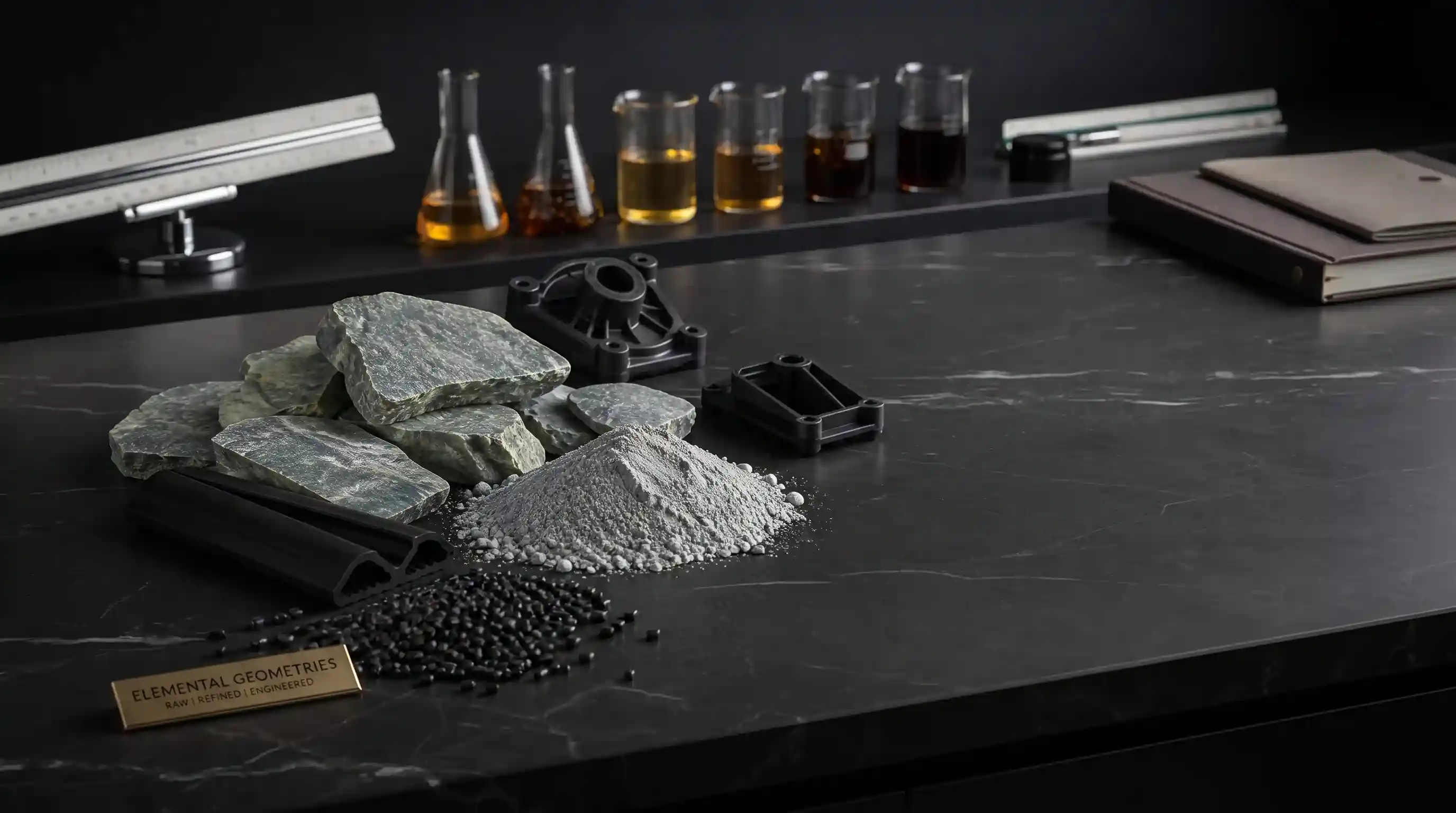
The Role of Industrial Talc in Reducing Factory Production Costs
An Introduction to the Importance of Cost Management in Industrial Production
In today's competitive world, managers of factories and production units are constantly looking for solutions to optimize processes and reduce finished product costs. Efficient management of raw materials is considered one of the main pillars in achieving this goal. The use of high-quality mineral fillers and additives can play a decisive role in this regard. Among various minerals, industrial talc, due to its unique physical and chemical properties, is recognized as one of the primary options in various industries that helps factories reduce costs.
Manufacturing industries require a material that, in addition to improving the final properties of the product, is also economically affordable. A detailed market analysis shows that the right choice of raw materials can significantly increase the profit margins of factories. In this context, familiarity with related topics such as the impact of dolomite on reducing production costs in the mining industry also provides a broader perspective on optimal mineral management. However, talc holds a special place in industrial formulations due to its flaky structure and specific softness.
Reducing production costs does not only mean buying cheap materials; it also includes optimizing consumption and improving production efficiency. When a mineral can cover a portion of expensive resin or polymer, significant economic savings occur. This approach is accepted as a standard in many large factories around the world. In the following sections of this article, we will examine the various dimensions of using this valuable material in reducing industrial costs.
A precise understanding of talc's properties and matching them with the needs of the production line is the first step toward savings. Research and development units of factories can achieve more optimal formulations by utilizing this material. This not only reduces costs but also maintains and enhances the quality of products.
Understanding the Structure and Technical Properties of Industrial Talc
Talc is a hydrated magnesium silicate known by a specific chemical formula. The layered and flaky structure of this material makes it exhibit lubricant-like behavior. This unique physical characteristic distinguishes industrial talc from other mineral powders and makes it an ideal option for improving the processability of materials. High softness and resistance to heat and chemicals are other prominent features of this material.
In mineral processing, particle sizing and mesh grading are of great importance. Industrial talc is produced and supplied in the 450 to 1000 mesh range, which allows it to be used in a wide range of industries. Micronized talc powder with these particle dimensions disperses well in various matrices and prevents particle agglomeration. To better understand the impact of these materials, reading the article the key role of industrial talc in improving the quality of manufactured products will be very helpful.
Talc's optical properties, including its whiteness and brightness, are also very important in applications such as paint manufacturing. This material acts as a functional filler and, due to its chemical neutrality, does not react negatively with other components of the formulation. The thermal stability of talc ensures that it maintains its structure and does not degrade in high-temperature processes.
An examination of talc's technical specifications shows that this material can be a suitable substitute for some more expensive fillers without causing a decrease in the quality of the final product. Factories looking to optimize their raw material procurement costs can significantly increase the productivity of their production lines by relying on these technical features.

Application of Industrial Talc in the Polymer and Plastic Industry
The polymer and plastic manufacturing industry is one of the largest consumers of industrial talc in the world. Adding this mineral to polymers as a filler brings numerous technical and economic advantages. Due to its flaky structure, talc can significantly improve the flexural modulus, hardness, and dimensional stability of plastic parts while simultaneously helping to reduce the cost of raw materials.
In the process of producing polymer products, the use of industrial talc acts as a nucleating agent and increases the rate of crystallization. This improves cycle times in plastic injection molding machines, thereby increasing energy and time efficiency in factories. Furthermore, reducing the consumption of expensive base polymers by replacing a portion of them with talc powder brings significant financial savings to the manufacturer.
Talc-filled polymer products show better resistance to heat and dimensional changes. This feature is particularly important in the production of automotive parts, home appliances, and packaging containers. The selection of the 450 to 1000 mesh range is made according to the type of polymer and the needs of the final application to ensure optimal particle distribution in the polymer matrix.
Production managers in the plastics industry, by leveraging modern knowledge and optimal use of industrial talc, can guarantee the quality and durability of the output products while simultaneously reducing raw material purchase costs. This balance between price and quality creates a high competitive advantage in the market.
The Role of Industrial Talc in the Rubber Industry
The rubber industry requires additives that can improve the mechanical properties of elastomers while controlling production costs. Industrial talc is used as an active and semi-active filler in rubber compounds. Due to its excellent impermeability to gases and moisture, it is widely used in the production of various rubber products such as gaskets, hoses, tires, and sealing strips.
When industrial talc is added to the rubber compound, it facilitates the flow behavior of the compound during the curing and molding process. This feature significantly helps in reducing energy consumption in extruders and curing presses. Additionally, due to the more affordable price of talc compared to some synthetic rubbers and carbon black, the overall production cost is noticeably reduced.
The appropriate sizing of talc in the 450 to 1000 mesh range ensures that the particles are uniformly distributed in the rubber mass and do not create stress concentration points. This helps maintain tensile strength and elongation at break. Besides talc, other minerals are sometimes studied in related industries; however, the role of talc is unparalleled due to its inherent lubricating property.
By optimizing their formulations and incorporating optimal amounts of industrial talc, factories producing rubber products have been able to effectively manage finished production costs while maintaining strict quality standards and preserving their profitability in the market.

Optimizing Paint and Industrial Coatings Formulations with Talc
The paint and resin industry is always looking for fillers that can improve coverage, stability, and surface characteristics of paint. Thanks to its suitable whiteness, chemical neutrality, and flaky structure, industrial talc is one of the most widely used minerals in the formulation of various architectural and industrial paints. This material acts as an extender and helps reduce the consumption of titanium dioxide, which is an expensive material.
The presence of talc in paint improves resistance to abrasion, moisture, and atmospheric factors. Also, the flaky structure of talc particles in the paint creates a physical barrier against the penetration of water and oxygen to the substrate, which significantly increases the anti-corrosive property of the paint. Selecting the 450 to 1000 mesh range for paint applications helps achieve the desired viscosity and prevents particle settling.
Beyond paint, diverse applications of minerals are seen in advanced chemical industries; for example, reading the article the role of kaolin in the production of advanced chemical catalysts shows how the precise selection of minerals can revolutionize dependent industries. However, in the paint industry, talc has a special place due to its matting properties and improvement of paint application characteristics on surfaces.
Paint manufacturing factories can use industrial talc to achieve more economical formulations that are both more attractive in terms of finished price for the consumer and offer high quality standards. This material is considered a powerful tool for reducing production costs without sacrificing quality in the paint industry.
The Impact of the 450 to 1000 Mesh Range on Production Efficiency
One of the most important parameters in determining the quality and efficiency of micronized mineral powders is the particle size and their mesh range. Industrial talc is supplied in the 450 to 1000 mesh range, and each segment of this spectrum has a special application in various industries. Coarser particles may be suitable for applications requiring volumetric filling, while finer meshes are used for thin coatings and sensitive polymers.
Precision in selecting the appropriate mesh range allows factories to maximize the efficiency of mixing and extrusion processes. Particles that are too coarse can cause nozzle blockages or a decrease in the mechanical properties of the final product, and particles that are too fine may increase the energy consumption of mills and mixers. Therefore, the 450 to 1000 mesh range is recognized as an optimal industrial range.
This particle size distribution is such that it maintains an optimal balance between the specific surface area of the particles and the fluidity of the powder. Consequently, production line operators can mix talc powder with other raw materials more easily. This reduces production line downtime and increases overall productivity.
Leading factories, through expert consultation and precise selection of the required mesh from the 450 to 1000 range, prevent raw material waste and minimize their operational costs. This precision in selecting technical specifications is an effective step toward lean and economical production.

Reducing Waste and Increasing Energy Efficiency in Factories
Cost management in production units is not limited to the price of raw materials; reducing production waste and optimizing energy consumption are also of great importance. Due to its lubricating properties and thermal stability, industrial talc helps reduce internal friction in polymer and rubber process machinery. This leads to reduced mechanical load on machine motors, resulting in electricity savings.
Furthermore, using talc with uniform sizing (450 to 1000 mesh) reduces fluctuations in the production line and minimizes the rate of defective products and waste. When the raw material is well dispersed in the matrix, the quality of the final product becomes more homogeneous, and the rate of non-standard products exiting the line is drastically reduced.
Reducing waste means direct savings in raw material purchase costs as well as waste disposal costs. Factories that implement quality management systems, by closely monitoring mineral inputs such as talc, have been able to identify and eliminate hidden production costs.
The principled application of industrial talc in production lines makes the manufacturing cycle smoother and allows factories to operate with higher capacity and lower operational costs. This economic advantage has made talc one of the most popular minerals among production engineers.
Conclusion and Economic Outlook of Using Talc in Industry
A comprehensive review of the applications of industrial talc shows that this mineral, beyond being a simple filler, plays a vital role in the economic structure of factories. From polymer and rubber industries to paint and other industrial products, the presence of talc has improved formulations and significantly reduced finished costs. The selection of the 450 to 1000 mesh range has provided the necessary flexibility to adapt to various engineering needs.
The Kani Sang Amiran project, by focusing on the supply and distribution of high-quality minerals, has provided a suitable platform for industries to access this valuable material. Intelligent cost management in the current economic climate requires the use of raw materials that create the highest added value. Industrial talc is exactly the answer to this need, offering high economic justification by combining superior technical properties with an affordable price.
Ultimately, factories that move toward optimized use of mineral additives will gain a greater market share. Continuous improvement of product quality and reduction of production costs are the keys to survival and development in today's competitive market. As a strategic tool in the hands of production managers, industrial talc plays its role in the best possible way.
The future outlook for manufacturing industries shows that the demand for high-quality processed minerals is on the rise. Investing in a precise understanding and correct application of industrial talc can guarantee the long-term profitability of production units and pave the way for sustainable development.
| Question |
Answer |
| What is industrial talc? |
It is a mineral substance made of hydrated magnesium silicate with a flaky structure, used in polymer, rubber, paint, and industrial applications as a filler and property improver. |
| What is the mesh range of the supplied industrial talc? |
The industrial talc supplied by the Kani Sang Amiran project is produced and offered in the 450 to 1000 mesh range. |
| What are the main applications of industrial talc? |
The main applications of this material include polymer products, rubber products, paint, and various industrial products. |
| How does industrial talc help reduce production costs? |
By replacing a portion of expensive raw materials such as resins and polymers, as well as by improving flowability and reducing energy consumption in the production process. |
| Does industrial talc negatively affect the quality of final products? |
No, industrial talc preserves and enhances the final quality of products by improving dimensional stability, hardness, thermal resistance, and surface characteristics. |
| What is the role of talc in the paint industry? |
Talc acts as an extender, improves paint coverage, and helps reduce the consumption of titanium dioxide. |
| Why is the 450 to 1000 mesh range important? |
This particle size range helps in the uniform distribution of particles in various matrices and creates an optimal balance between powder fluidity and mechanical properties. |
| What is the impact of talc on the rubber industry? |
It improves the processability of the rubber compound, reduces permeability to gases, and lowers finished production costs. |
| How can industrial talc be purchased? |
To purchase and obtain more information, you can visit the industrial talc product page on the Kani Sang Amiran website. |
| Does using talc help reduce waste? |
Yes, due to better uniform distribution and homogenization of raw materials, the amount of production line waste is noticeably reduced. |
Specialized mineral resources and technical information of the Kani Sang Amiran project.
:: برچسبها:
Industrial Talc ,
The Role of Industrial Talc in Reducing Factory Production Costs ,
:: بازدید از این مطلب : 0
|
امتیاز مطلب : 0
|
تعداد امتیازدهندگان : 0
|
مجموع امتیاز : 0


 عضو شوید
 عضویت سریع
 آمار مطالب
 آمار بازدید


