
The Vital Role of Calcium Carbonate in Industrial Fillers
Introduction to the Vital Role of Calcium Carbonate in Modern Industries
Minerals are recognized as the backbone of many manufacturing and engineering industries, and among them, calcium carbonate holds an unrivaled position. Due to its unique physical and chemical properties, this valuable material is considered one of the most widely used fillers in the world. Various industries are heavily dependent on this material to improve mechanical properties, reduce production costs, and enhance the quality of their final products. At the Kani Sang Amiran project, a deep focus has been placed on supplying and processing this mineral with high standards to best meet the needs of various industries.
The use of fillers in industrial processes is not just about reducing the final product price; improving dimensional stability, increasing stiffness, and controlling viscosity are its key advantages. To learn more about our wide range of products, you can visit the calcium carbonate purchase page to obtain complete information about technical specifications and various mesh sizes. By having a wide mesh range that includes coarse to very fine particles, this material provides high flexibility in industrial formulations.
A deep understanding of the behavior of calcium carbonate in polymer, paint, and paper matrices helps engineers and industrial designers produce more optimized products. The consistency and uniformity of the particles of this material play a direct role in the final quality of engineering goods. Given the increasing importance of optimizing raw material consumption, a detailed examination of the applications of this mineral in different industrial sectors opens up new horizons for manufacturers.
Technical Features and the Importance of Mesh Range in Industrial Applications
One of the most important parameters in choosing this mineral is the particle size distribution and its mesh range. The 100 to 3500 mesh range allows this material to be used in a wide range of applications, from simple construction fillers to advanced engineering nanocomposites. Coarser particles are usually used in cases where dimensional stability and high volume filling are required, while very fine and micronized meshes are used in paints, advanced coatings, and specialized polymers.
The quality of grinding and chemical purity determine the behavior of this material during mixing. Expertise in producing powders with uniform particle size distribution prevents particle agglomeration and creates a homogeneous dispersion in the base matrix. This feature is of vital importance, especially in sensitive industries such as masterbatch and plastic pipe production.
Furthermore, selecting the correct mesh according to the type of production process prevents problems such as a drop in mechanical properties or equipment clogging. By being aware of these technical specifications, manufacturers can maximize the productivity of their production lines and bring products with the highest quality standards to the market.

Application of Calcium Carbonate in Polymer, Profile, and PVC/UPVC Pipe Industries
The polymer industry, and especially the production of PVC/UPVC pipes and profiles, is one of the major consumers of this mineral. Adding this filler to the formulation of plastic pipes not only reduces final costs but also significantly improves the impact resistance, modulus of elasticity, and thermal stability of the product. In this regard, reviewing specialized articles such as the role of calcium carbonate in plastic pipe production provides engineers with deeper insights into reinforcement mechanisms and formulation standards.
In addition to pipes, this material is also widely used in the production of various masterbatches and electrical cables. In the cable manufacturing industry, electrical insulation properties and heat resistance are heavily influenced by the quality of mineral fillers. The uniform distribution of particles in the cable's polymer matrix guarantees the durability and safety of the product under harsh working conditions.
The optimal use of this material in the production of UPVC construction profiles increases stiffness and resistance against deformations caused by environmental thermal and mechanical stresses. This significantly helps to increase the useful life of double-glazed windows, doors, and building installations.
The Role of Filler in Paint, Resin, and Adhesive Industries
In paint and industrial coating industries, the choice of fillers has a direct impact on gloss, covering power, weather resistance, and paint adhesion. Due to its high whiteness and suitable refractive index, calcium carbonate acts as a reinforcing pigment and replaces part of the expensive titanium dioxide in the paint formulation without causing a noticeable drop in appearance quality.
In the production of adhesives and sealants, this material also acts as a viscosity regulator and improves tensile properties. Controlling the viscosity of the adhesive during application and preventing it from running on vertical surfaces are among the advantages of using micronized powders of this material in the adhesive manufacturing industry.
Also, the presence of this material in synthetic leather formulations improves the hand-feel, increases abrasion resistance, and controls the flexibility of the final product. This wide range of applications demonstrates the high compatibility of this mineral with various chemical and resin systems.
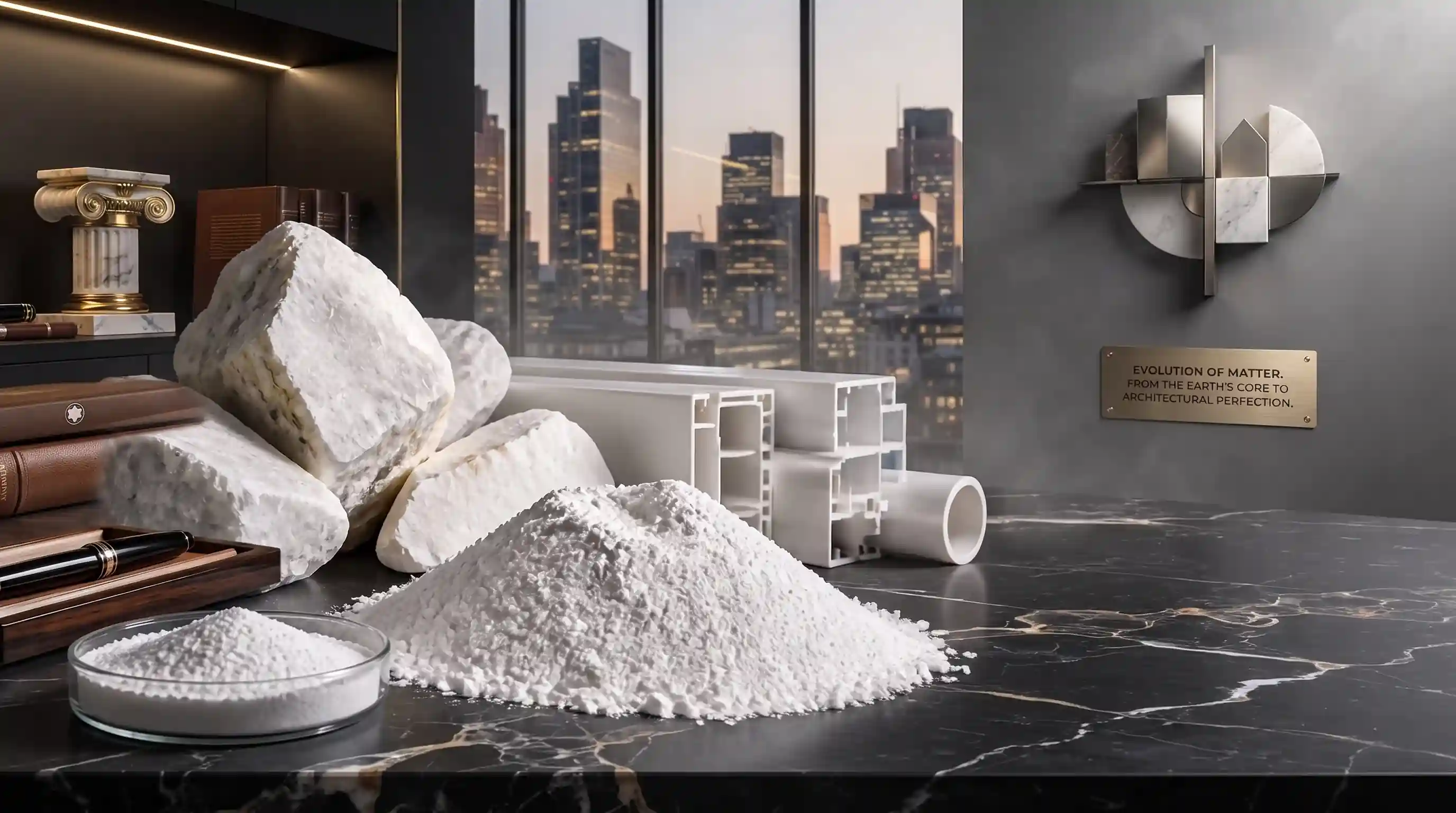
Advanced Applications in Paper Production and Engineering Products
The papermaking industry is another traditional yet advanced field consuming mineral fillers. Adding this material to paper pulp increases whiteness, improves printability, increases opacity, and reduces ink penetration. Also, due to the neutral or alkaline nature of the process environment, the use of this filler significantly increases the useful life of the paper and prevents it from yellowing over time.
In the field of engineering products, engineered stone is one of the most modern applications that uses large amounts of mineral powder and granules. These synthetic stones with a resin base and mineral fillers have become a very suitable alternative to natural stones in interior decoration and building facades.
The precise combination of polyester or epoxy resins with different meshes of this material creates stones with high mechanical resistance, near-zero water absorption, and highly diverse designs that have raised building industry standards.
Comparison with Other Minerals and Their Role in the Industrial Cycle
Although this mineral holds a special place in fillers, industrial engineers also use other specialized minerals alongside it based on the specific needs of the projects. For example, in water treatment and industrial wastewater management processes, the use of adsorbent materials is vital; reading the article the role of bentonite in water and industrial wastewater treatment provides complete information in this field.
Also, in advanced chemical industries, catalysts play a key role in accelerating reactions. To better understand the application of aluminum silicates in this field, reading the specialized article the role of kaolin in advanced chemical catalyst production is suggested, which reveals the differences and synergies of mineral materials.
A comprehensive examination of these materials shows that each mineral has unique features, and their intelligent selection alongside calcium carbonate is the key to success in optimizing complex industrial and engineering formulations.

Quality Control Standards and Mineral Processing at Kani Sang Amiran
The production of standard mineral powders requires complex processes of extraction, crushing, classification, and precise quality control. At the Kani Sang Amiran project, all stages from the mine to the final product are under the strict supervision of quality control experts to ensure the chemical purity and mesh distribution of the products.
The presence of metallic impurities or coarse particles outside the mesh range can disrupt customers' advanced production lines. For this reason, using modern separation and micronization equipment to achieve a homogeneous product free from any contamination is one of the main priorities of the group.
The commitment to sustainable quality and continuous supply of raw materials needed by the polymer, paint, paper, and adhesive industries has earned the trust of the country's industrial sector activists, and this path continues by relying on technical knowledge and innovation.
Future Outlook and Development of New Applications for Mineral Fillers
With the advancement of nanotechnology and the effort to create lighter and more resistant composites, the role of calcium carbonate has become more important than ever. Extensive research is being conducted on the production of nanoparticles of this material and their use in advanced engineering polymers, which will bring great innovations in the automotive, aerospace, and packaging industries.
Optimizing energy consumption in production processes and reducing environmental impacts are other growing trends in the mining and raw materials industry. The use of natural mineral fillers, due to their greater environmental compatibility compared to petrochemical-based materials, is an effective step towards sustainable development.
The Kani Sang Amiran group, by closely monitoring market needs and new technologies, moves in step with leading industries and always declares its readiness to provide expert advice and supply the best mineral materials.

| Question |
Answer |
| What is calcium carbonate and what are its applications? |
It is a natural mineral compound used as a filler in polymer, paint, paper, adhesive, and PVC/UPVC pipe industries. |
| What values does the mesh range of this product include? |
This product can be supplied and offered in the 100 to 3500 mesh range. |
| Is this material used in the pipe manufacturing industry? |
Yes, it is used as a key filler in the production of PVC/UPVC profiles and pipes to improve mechanical properties. |
| What is the role of this material in the paint industry? |
It acts as a reinforcing pigment, improving gloss, covering power, and reducing paint formulation costs. |
| How can this product be purchased? |
You can do so through the dedicated product page on the Kani Sang Amiran website. |
| Is this filler also used in the paper industry? |
Yes, it is used to increase whiteness, opacity, printability, and paper durability. |
| What is the effect of this material on synthetic leather? |
It improves the hand-feel, abrasion resistance, and controls the flexibility of synthetic leather. |
| Is it also used in the production of engineered stone? |
Yes, it plays a role as the main filler along with resin in the production of synthetic engineered stones. |
| Why is particle size distribution important? |
It is vital for preventing particle agglomeration, homogeneous dispersion, and maintaining the mechanical properties of the final product. |
| Does the Kani Sang Amiran project provide technical advice? |
Yes, the group's experts provide the necessary guidance for selecting the appropriate mesh. |
Scientific sources and specialized Iranian mining and polymer engineering standards.
:: برچسبها:
Calcium Carbonate ,
The Vital Role of Calcium Carbonate in Industrial Fillers ,
:: بازدید از این مطلب : 2
|
امتیاز مطلب : 0
|
تعداد امتیازدهندگان : 0
|
مجموع امتیاز : 0


 عضو شوید
 عضویت سریع
 آمار مطالب
 آمار بازدید


