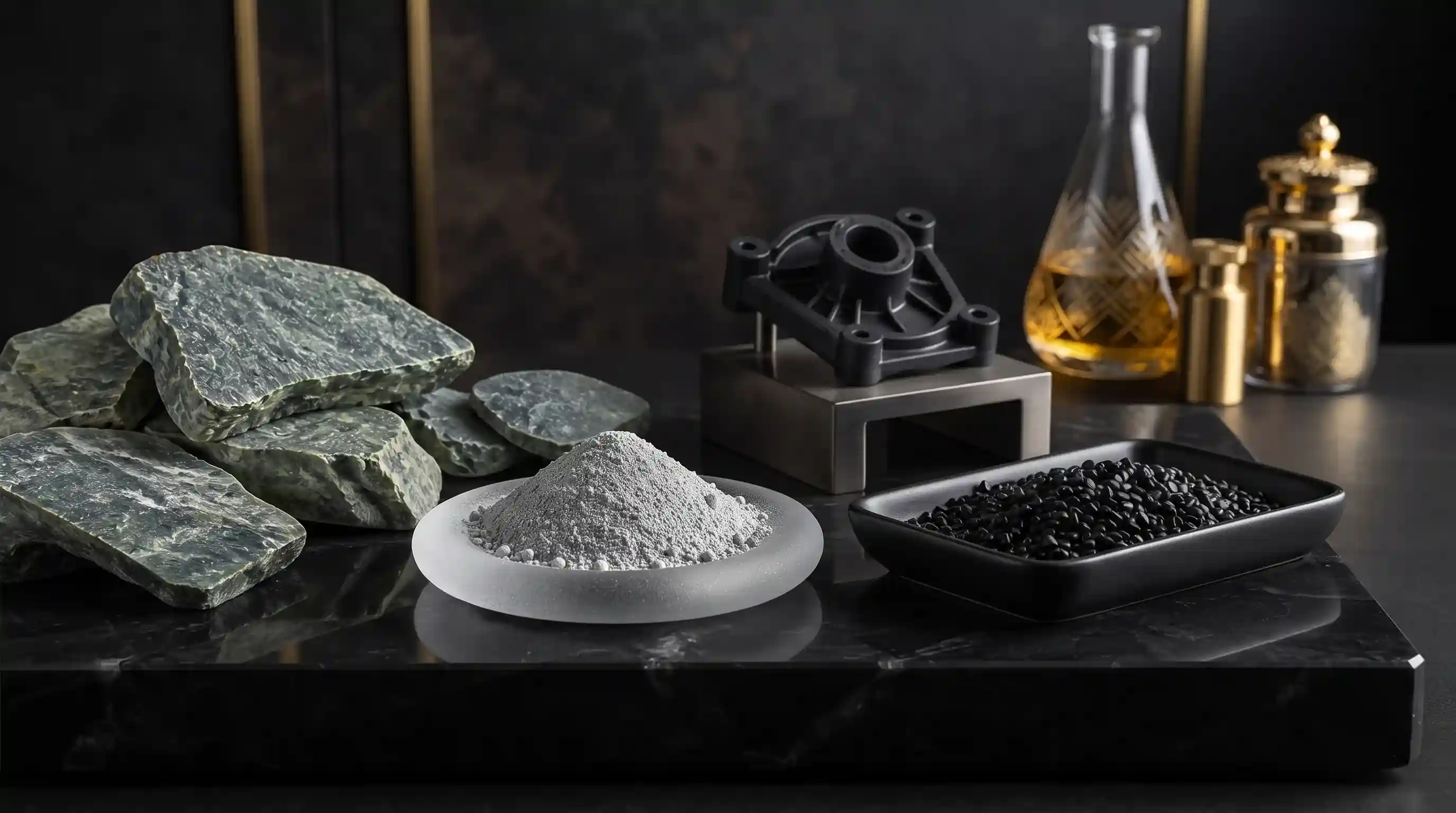
Understanding Standard Industrial Talc Packaging
Introduction to the Importance of Industrial Talc in Modern Industries
In today's world, industrial development requires high-quality, standardized raw materials that can ensure durability, efficiency, and the final quality of the product. Among the widely used minerals, Industrial Talc is recognized as one of the most key and versatile fillers and additives. Possessing unique physical and chemical properties, this mineral has found a special place in manufacturing processes. A precise understanding of the packaging type and storage standards for this material is of great importance for consuming industries to prevent quality degradation during storage and transportation.
Kani Sang Amiran project, focusing on supplying and processing high-quality minerals, strives to cover the needs of various industries with the highest quality standards. Since this material is used in sensitive industries such as polymers, rubber, and paint manufacturing, its packaging must be such that it prevents the penetration of moisture, environmental contamination, and the clumping of the powder. For more information about the supply method and standards of this product, you can visit the dedicated Industrial Talc page.
In this comprehensive article, we intend to examine various aspects of standard industrial talc packaging, its mesh range and grading, as well as its extensive applications in polymer, rubber, paint, and other industrial products. A careful review of these items helps engineers and purchasing managers make more optimal choices.
In addition to this material, examining other applicable minerals such as Getting to know the characteristics of industrial limonite oxide (yellow ochre) can provide industrial activists with a broader perspective on supplying engineering raw materials. Understanding the packaging standards for these materials ensures higher productivity in production lines.
Technical Specifications and Industrial Talc Mesh Range
One of the most important factors in determining the quality and application of this mineral is its purity and mesh range, also known as grading. The industrial talc mesh range usually varies between 450 to 1000 mesh, which allows for its use in various industrial formulations. Powders with higher mesh (finer particles) are usually considered the first choice for production engineers for applications that require a smoother and more uniform surface coating.
Precision in grading and particle uniformity directly affects the final properties of the product. For example, in the paint and coating industry, using talc with standard grading improves anti-skinning properties and increases the durability and optical stability of the paint film. Also, in the polymer industry, uniform distribution of particles in the plastic matrix significantly helps to increase mechanical strength and improve the dimensional stability of manufactured parts.
To learn more about the criteria for selection and quality assessment, reading the Guide to Buying Industrial Talc with the Best Quality and Reasonable Price will be very helpful. This guide covers key points regarding the matching of mesh range and type of application so that industrial buyers can make the best decision.
The Kani Sang Amiran project, using advanced crushing and classification equipment, processes this mineral in the 450–1000 mesh range with stable quality and supplies it to the market in standard packaging. Maintaining this standard mesh range in all production batches is a commitment that guarantees the final quality of consumers' products.

Role of Industrial Talc in Polymer and Rubber Industries
Polymer and rubber industries are among the largest consumers of micronized minerals worldwide. Industrial talc, as an efficient mineral filler, is considered an improver of the physical and mechanical properties of polymers and elastomers. Adding this material to polymer compounds increases the flexural modulus, hardness, and thermal stability of plastic parts while helping to reduce final production costs.
In the rubber industry, this material also plays a key role in improving the processability of rubber compounds, increasing tear resistance, and improving the dynamic properties of products. Proper distribution of powder particles in the rubber matrix prevents particle agglomeration and increases the structural integrity of the product. To achieve these goals, using raw materials with precise grading in the 450 to 1000 mesh range is mandatory.
In addition to polymer and rubber, examining the practical effects of other fillers and minerals such as Application of Industrial Barite in the Production of Sound and Thermal Insulation shows how the correct choice of minerals can simultaneously improve the thermal and acoustic properties of industrial parts.
Standard packaging for these powders ensures that the materials do not absorb moisture during transport to polymer and rubber production lines, and their rheological and mechanical properties remain intact. The Kani Sang Amiran project, with precision in the packaging process, guarantees the physical integrity of the product until the moment of use.
Application of Industrial Talc in the Paint and Specialized Coatings Industry
The paint and resin industry requires fillers and extender pigments that, in addition to reducing the final cost, help improve the optical and mechanical properties of the paint. Due to its lamellar structure, industrial talc is considered one of the best options for formulating various architectural, industrial, and anti-corrosion paints. This lamellar structure helps the final coating have very high resistance to moisture penetration and atmospheric factors.
Using this material in the 450 to 1000 mesh range leads to improved matting properties, increased abrasion resistance, and improved paint flow properties during application. The lamellar talc particles lie parallel on the paint surface and create a protective barrier against water and oxygen penetration, which significantly increases the useful life of the coating.
The Kani Sang Amiran project, by supplying high-quality industrial talc with precise grading, meets the need of paint manufacturers for uniform raw materials. The high quality of this mineral powder prevents problems such as hard sedimentation in storage and significantly helps maintain the homogeneity of the paint.
Adherence to packaging standards prevents foreign dust and impurities from entering the powder, which is of vital importance in the paint industry due to high sensitivity to foreign particles.

Standards and Storage Principles for Industrial Talc Packaging
Storage and warehousing of micronized minerals require adherence to specific principles to prevent quality degradation. Due to its powdery nature and high specific surface area, industrial talc is prone to absorbing environmental moisture. Moisture absorption can cause powder clumping, reduced flowability, and problems during weighing and introduction into production lines. For this reason, the choice of packaging type is of paramount importance.
The use of multi-layer laminated bags, polypropylene pockets with an internal layer resistant to moisture penetration, as well as palletized packaging and jumbo bags for high volumes, are among the common standards in supplying this product. These types of packaging not only protect the powder from atmospheric conditions but also make loading, unloading, and handling with forklifts and warehousing equipment much safer and easier.
The Kani Sang Amiran project, using modern packaging systems, prepares this product in a standard way for supply to various industries. Including complete product specifications, mesh range, and safety tips on each bag helps warehouse operators have better inventory management of raw materials.
Observing warehousing safety principles, such as placing pallets away from floors and walls, proper warehouse ventilation, and preventing bags from tearing, maximizes the shelf life of the product and protects the production line from unwanted downtime.
Economic and Logistical Benefits of Using Standard Packaging
In the industrial supply chain, logistics and transportation costs play a decisive role in the final price of the product. Standard industrial talc packaging, in addition to protecting product quality, provides numerous economic and logistical benefits for production units. The use of specific geometric dimensions in bags and jumbo bags allows for optimal arrangement (palletizing) in transport vehicles, which maximizes transportation space efficiency.
Reducing product losses due to bag tearing or moisture penetration is another financial advantage of using resistant packaging. When mineral powder is delivered in the standard packaging provided by the Kani Sang Amiran project, material waste reaches near zero, and consuming factories can have more accurate accounting of their raw material usage.
Furthermore, safe packaging ensures the health of human resources during unloading and working with powdery materials, as it prevents the release of toxic or nuisance dust in the workplace. These standards also facilitate the inventory and tracking process of production batches by including readable information labels.
Therefore, investing in purchasing raw materials with standard packaging reduces hidden production costs in the long run and improves the overall efficiency of consuming factories.

Role of Quality Control in the Production and Packaging Process of Industrial Talc
Comprehensive quality control is the backbone of sustainable production in the mineral industry. Industrial talc must be under strict laboratory supervision from the stage of raw ore extraction to the crushing, micronization, and final packaging processes to meet the necessary standards. Parameters such as percentage of purity, powder whiteness, particle size distribution in the 450–1000 mesh range, and moisture content must be continuously measured.
In the packaging section, quality control of bag weight, stitching or shrinking strength, and the integrity of protective layers are of high importance. Any defect at this stage can expose the entire shipment to damage from moisture and contamination. The Kani Sang Amiran project, by establishing strict quality control systems, ensures that the final product reaches the consumer exactly with the declared technical specifications.
The quality control laboratories of this collection use modern grading equipment and physical tests to approve each production batch before packaging. This scientific approach allows polymer, rubber, and paint industries to implement their production formulations without worrying about quality fluctuations.
Documenting laboratory results and attaching a technical certificate to each shipment demonstrates a commitment to quality and transparency in providing mineral products, which earns the trust of industrial customers.
Market Outlook and Optimal Selection of Industrial Talc for Industries
With the continuous development of manufacturing industries and the increase in quality standards for final products, the demand for high-purity minerals with precise grading is constantly growing. Industrial talc, as a strategic additive in polymer, rubber, paint, and industrial product industries, plays a prominent role in enhancing the added value of goods. Purchasing managers and formulation engineers are always looking for suppliers who offer both consistency in quality and packaging standards simultaneously.
The Kani Sang Amiran project, relying on technical knowledge, rich mines, and advanced production lines, is recognized as one of the reputable mineral suppliers in the country. Providing this product in the 450 to 1000 mesh range with standard and resistant packaging meets the demanding needs of modern industries.
Making the right choice of raw materials and paying attention to logistical and packaging details is the main solution for reducing production risks and increasing competitiveness in the market. We hope this article has been able to provide a comprehensive and practical view of the importance of standard industrial talc packaging and its diverse applications so that an effective step can be taken towards improving the country's industrial processes.
To receive specialized advice, examine technical specifications in more detail, and inquire about the availability of this product, you can always contact the experts of the Kani Sang Amiran project through official communication channels and supply the best minerals for your production line.

| Question |
Answer |
| What is the mesh range of the supplied industrial talc? |
This product is processed and supplied in the standard mesh range of 450 to 1000. |
| What are the main applications of industrial talc? |
This material is used in the production of polymer products, rubber products, paint, and various industrial products. |
| How can more information be obtained about this product? |
You can visit the dedicated Industrial Talc page on the Kani Sang Amiran project website. |
| Is this product protected against moisture penetration? |
Yes, the standard packaging of this product is designed to prevent moisture penetration and powder clumping. |
| What is the role of talc in the paint industry? |
Due to its lamellar structure, it increases the paint's resistance to moisture penetration, abrasion, and atmospheric factors. |
| What is the impact of industrial talc on polymer industries? |
It increases flexural modulus, hardness, thermal stability, and reduces final production costs. |
| Is the packaging of this product suitable for transport and warehousing? |
Yes, using multi-layer and standard bags allows for safe loading and optimal palletizing. |
| Which group is the manufacturer and supplier of this product? |
Kani Sang Amiran project is the manufacturer and supplier of these minerals. |
| Why is choosing an exact mesh range important in production? |
Uniform grading helps better distribution of particles in the product matrix and improves final mechanical properties. |
| Is there another guide for buying minerals? |
Reading the specialized buying guide on the site provides you with complete information about choosing the best quality. |
Kani Sang Amiran Project — Reference for production and processing of industrial minerals.
:: برچسبها:
Industrial Talc ,
Understanding Standard Industrial Talc Packaging ,
:: بازدید از این مطلب : 0
|
امتیاز مطلب : 0
|
تعداد امتیازدهندگان : 0
|
مجموع امتیاز : 0

 عضو شوید
 عضویت سریع
 منوی کاربری

 آمار مطالب
 آمار بازدید


