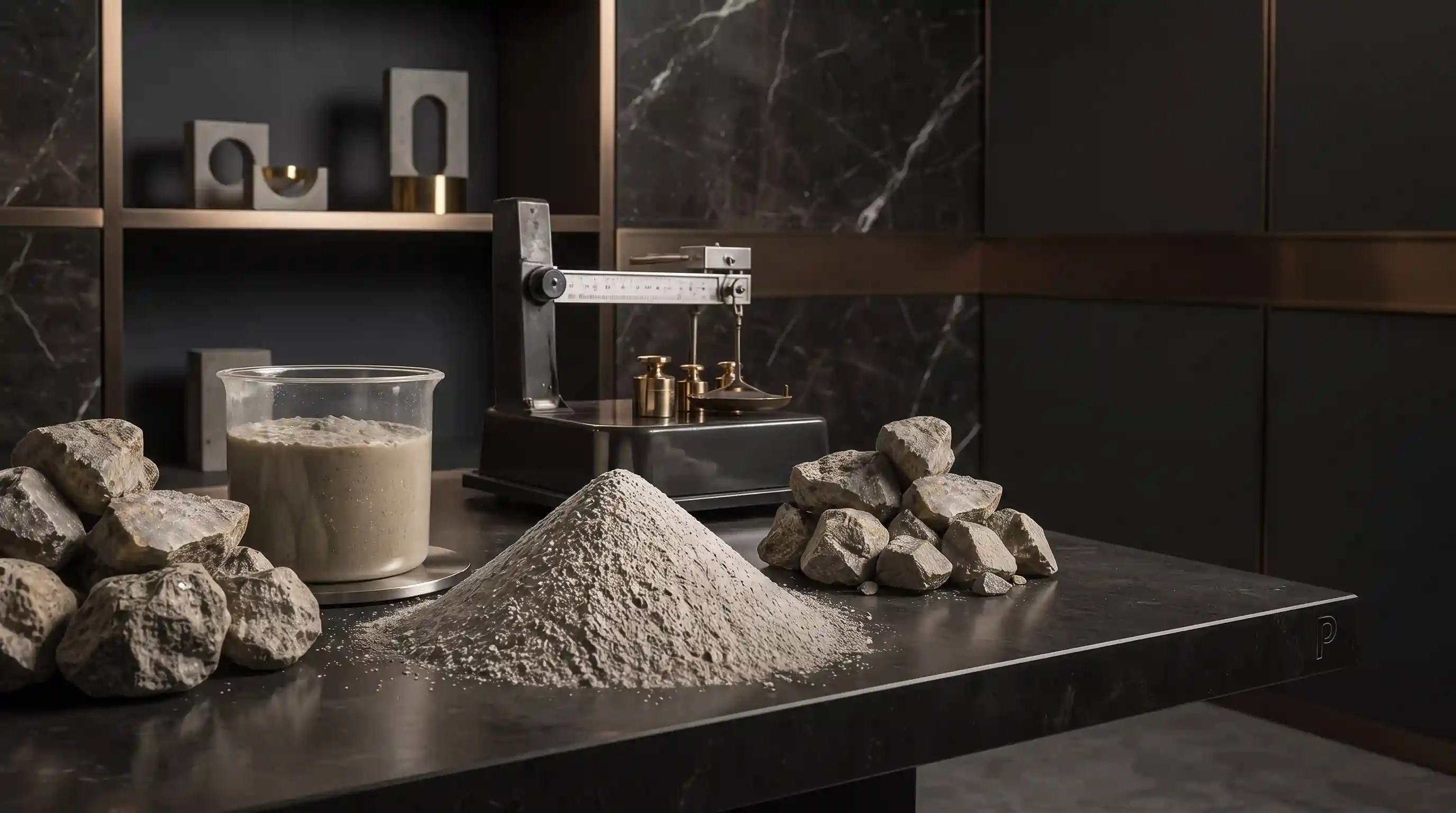
Application of Industrial Barite in the Production of Polymeric Filler Materials
Introduction to Industrial Barite and Its Importance in Modern Industries
Industrial barite is recognized as one of the most important and applicable minerals in various industries, possessing unique physical and chemical properties. With high density and appropriate purity, this mineral plays a vital role in optimizing industrial processes. A precise understanding of its properties enables engineers and manufacturers to significantly increase the efficiency of their production lines.
In the mineral supply chain, industrial barite is introduced as an efficient filler and weighting agent that has secured a special position in heavy and light industries. Examining the structural characteristics of this material reveals how crucial the correct choice of mesh size and powder quality is for the final product. In the continuation of this article, we will examine the various dimensions of using this valuable material in detail.
Mineral producers always strive to supply a high-quality and homogeneous product to the market through precise processing. The Kani Sang Amiran project, focusing on standard extraction and processing, prepares this mineral for specialized applications. Understanding the diverse applications of this mineral powder provides a clear perspective of its added value in polymeric and non-polymeric manufacturing industries.
In addition to traditional applications, industrial research shows that this material also plays a key role in optimizing the mechanical properties of rubber and plastic products. Compliance with warehousing standards for this material is of high importance, and for more information, you can refer to the comprehensive guide to warehousing and storage of industrial white barite powder to familiarize yourself with the safety principles and preservation of its quality.
Physical and Chemical Properties of Industrial Barite
Industrial barite has special physical properties, the most prominent characteristic of which is its high density (heaviness). This feature makes it the primary choice in cases where it is necessary to increase weight or create compaction in the material structure. Crystal structure and high chemical stability against acids and bases are among its other advantages.
The mesh size range of this material is usually between 200 and 450 mesh, and this particle size range allows for the homogeneous distribution of the powder in various polymeric and liquid matrices. Precise particle sizing ensures that the powder is well blended and prevents particle agglomeration. This feature plays a direct role in improving the final quality of the product.
The stable chemical composition of this material ensures that it does not react negatively to environmental factors, heat, and mechanical stresses, thereby preserving the overall structure of the product. Favorable thermal stability makes it fully suitable for industrial processes requiring high temperatures. These inherent properties double its economic and practical value.
Compared to other mineral fillers, understanding the behavior of industrial barite helps engineers design more precise formulations. For example, examining the synergy of this material with other additives, such as the key role of industrial talc in improving the quality of manufactured products, can pave the way for developing new polymeric and composite products.
Application of Industrial Barite in the Production of Polymeric Filler Materials
One of the main areas of consumption for industrial barite is its use as a filler material in the plastics and rubber industries. Adding this material to polymeric compounds improves mechanical properties, increases the modulus of elasticity, and enhances the dimensional stability of manufactured parts. The 200 to 450 mesh range allows particles to be uniformly distributed within the polymer matrix.
In the rubber manufacturing industry, using this mineral as a filler improves wear resistance, reduces gas permeability, and increases the specific gravity of the part. Also, in the plastics industry, due to its chemical inertness, it does not create adverse reactions with polymeric resins and acts as an economical and efficient filler.
Precise adjustment of the filler percentage in polymer formulations requires technical knowledge and a precise understanding of particle behavior. By supplying high-quality powder, the Kani Sang Amiran project provides a suitable foundation for manufacturers to produce polymeric products with high standards. The proper distribution of particle size within the mentioned mesh range prevents any loss in impact resistance properties.
Engineering investigations show that the application of industrial barite is not limited to plastics and rubber alone, but it is also efficient in other ancillary industries. Among these, we can mention the application of industrial barite in the production of sound and thermal insulation, which exhibits extraordinary performance in reducing sound and heat transfer due to its high density.
The Role of Industrial Barite in the Rubber and Plastic Industries
The rubber and plastic industries are constantly looking for additives that not only reduce final costs but also enhance the quality properties of the product. As a heavy mineral filler, industrial barite plays a significant role in controlling the shrinkage of plastic parts after the molding process and ensures dimensional stability.
In the production of engineered rubber parts, the presence of this material improves the modulus and hardness of the rubber without having a serious negative effect on the elongation at break. The proper distribution of particles in the 200 to 450 mesh range greatly helps in creating a smooth and uniform surface in rubber and plastic products.
Using this mineral in extrusion and plastic injection processes improves the flowability of the polymer melt under optimal conditions. This helps reduce machine pressure and increases production speed. By carefully selecting the appropriate particle sizing, manufacturers maximize the efficiency of their production lines.
The quality and purity of the industrial barite supplied by the Kani Sang Amiran project guarantee its flawless performance in rubber and plastic compounds. The absence of harmful impurities ensures that the final products have a longer lifespan and better physical resistance against harsh working conditions.
Application of Industrial Barite in Drilling Fluids and Mud
One of the classic and vital applications of industrial barite is its extensive use in the oil and gas industry as a weighting agent for drilling fluids. The high density of this mineral allows the specific gravity of the drilling mud to be easily adjusted and the pressure of underground formations to be well-controlled.
Maintaining downhole pressure balance and preventing reservoir fluid blowouts are among the primary tasks of drilling mud containing this mineral. Because barite powder is inert to various wellbore fluids, it does not create undesirable chemical reactions and maintains the stability of the drilling system.
Proper particle sizing in the 200 to 450 mesh range plays an important role in keeping particles suspended in the drilling fluid. If particles are too coarse, they settle, and if they are too fine, they increase fluid viscosity uncontrollably. Therefore, the precise selection of mesh size is of high importance.
Through standard processing of this mineral, the Kani Sang Amiran project supplies the country's drilling industries with a homogeneous, high-density powder. This leads to an increased safety factor in drilling operations and reduced costs associated with well control.
Application of Industrial Barite in Welding Electrode Production
In the welding electrode manufacturing industry, industrial barite is recognized as a key component of the electrode flux coating. This material helps adjust electric arc properties, arc stability, and creates suitable slag to protect the molten pool.
The appropriate density and melting point of this mineral allow it to maintain stability at high welding temperatures and assist in the better flow and formation of slag. The presence of this powder in the electrode coating noticeably improves the quality of the weld joint.
Choosing the proper mesh size for electrode application is extremely vital because the particles must blend well with other chemicals and binders to create a uniform coating on the metal rod. The standard mesh range processed by the Kani Sang Amiran project well meets this industrial need.
By utilizing this high-quality mineral, electrode manufacturers can produce products with high standards and stable performance in industrial welding operations. This specialized application demonstrates the breadth and diversity of industrial barite uses across various industries.

Technical and Engineering Tips in Selecting and Purchasing Industrial Barite
Selecting the appropriate industrial barite requires a careful review of technical parameters including apparent density, barium sulfate purity percentage, moisture content, and particle size distribution. A precise understanding of these parameters helps engineers choose the best option according to their process requirements.
The 200 to 450 mesh range, as the most common consumption range, requires continuous quality control in production lines to ensure the absence of lumps and coarse impurities. The quality of mine processing plays a direct role in the final performance of the powder in polymeric and drilling industries.
Observing safety tips and warehouse storage principles is another important matter that buyers must pay attention to. Improper storage and exposure to severe moisture can affect powder quality and cause problems arising from caking.
By providing accurate and transparent technical specifications, the Kani Sang Amiran project has facilitated the decision-making and purchasing process for consuming industries. Direct communication with a reputable supplier guarantees receiving a product that matches the expected quality standards.
Conclusion and Future Prospects of the Industrial Barite Market
As a strategic mineral, industrial barite plays an undeniable role in advancing the production goals of various industries such as plastics, rubber, drilling, and electrode manufacturing. Outstanding physical properties such as high density and chemical stability create high added value for final products.
The continuous development of modern technologies and the industrial need for high-quality, economical filler materials have driven the growth in demand for this mineral. Standard and precise processing in the 200 to 450 mesh range is considered the main key to success in meeting strict industrial requirements.
Utilizing rich mines and advanced processing lines, the Kani Sang Amiran project has managed to secure a firm position in the sustainable supply of high-quality industrial barite in the domestic market. Focusing on upgrading product quality guarantees the satisfaction of consuming industries.
Ultimately, investing in research and development for new applications of this mineral and optimizing polymeric formulations will pave a very bright future for the better use of industrial barite ahead.

| Question |
Answer |
| What is industrial barite? |
It is a high-density mineral with suitable purity used as a filler and weighting agent in various industries. |
| What is the mesh size range of Kani Sang Amiran industrial barite? |
This product is processed and supplied in the 200 to 450 mesh range. |
| What are the main applications of industrial barite? |
Drilling fluids, electrode manufacturing, rubber products, and various plastic products are its main applications. |
| Why is barite used in the plastics and rubber industries? |
It is used to improve mechanical properties, increase the modulus of elasticity, enhance dimensional stability, and reduce the final price of the part. |
| What is the role of barite in drilling fluids? |
It is used as a weighting agent to adjust the density of drilling mud and control well pressure. |
| What is the application of barite in electrode production? |
It helps adjust electric arc properties and produce protective slag in the electrode coating. |
| How can high-quality industrial barite be procured? |
Standard products can be obtained through reputable mineral suppliers such as the Kani Sang Amiran project. |
| Is industrial barite heat resistant? |
Yes, this material has high thermal and chemical stability against acids and bases. |
| What is an important point in storing barite powder? |
Preventing moisture penetration and keeping the powder in suitable packaging to avoid caking is very important. |
| How does barite density affect quality? |
High density leads to the excellent performance of this material in weighting and creating compaction in various products. |
Scientific sources and national and international standards for mineral and polymer processing
:: برچسبها:
Industrial Barite ,
Application of Industrial Barite in the Production of Polymeric Filler Materials ,
:: بازدید از این مطلب : 0
|
امتیاز مطلب : 0
|
تعداد امتیازدهندگان : 0
|
مجموع امتیاز : 0


 عضو شوید
 عضویت سریع
 آمار مطالب
 آمار بازدید


