
Application of Kaolin in the Production of Agricultural Fertilizers and Pesticides
Introduction to Kaolin and Its Role in Modern Industries
The mineral kaolin is known as one of the most important hydrated aluminum silicates, which has gained a special position in various industries due to its unique physical and chemical properties. With a specific layered structure and suitable purity, this natural material is used as a filler, coating agent, and vital raw material in manufacturing processes. A precise understanding of the properties of this mineral enables engineers and manufacturers to significantly increase the efficiency of their production lines.
In recent years, the applications of this material have gone beyond traditional uses and entered new specialized fields. Given the importance of raw material quality in the mining industries, the Kani Sang Amiran project focuses on precise processing, providing consumers with a high-standard product with suitable granulation. The micronization process of this material plays an important role in improving the final properties of industrial products.
One of the prominent features of this mineral is its thermal and chemical stability under various conditions. This feature makes it usable in various industries including the production of ceramics, paint, paper, and even in advanced chemical processes. For example, in discussions related to the development of modern technologies, examining the role of kaolin in the production of advanced chemical catalysts shows how much this material can be effective in improving industrial reactions.
In addition to the mentioned items, due to its appropriate specific surface area and favorable rheological properties, this material plays a regulating role in complex industrial formulations. The correct use of this mineral not only guarantees the quality of the final product but also optimizes production costs. Deep knowledge of this material and its mesh sizing characteristics is the solution for many manufacturing industries.
Characteristics and Technical Specifications of Micronized Kaolin
The physical and chemical specifications of minerals are the main determinants of their application in various industries. The micronized kaolin powder produced by the Kani Sang Amiran collection has a very precise mesh size range between 450 and 1500 mesh. This wide range of granulation allows industrialists to choose the appropriate mesh based on the exact needs of their production process and get the best result.
The appearance properties of this material include a white to off-white color, non-toxicity, chemical neutrality, and excellent dispersion in aqueous and oil environments. These features allow the mentioned powder to easily spread in various matrices without causing undesirable changes in the system's properties. Also, the low hardness of this material prevents the wear of industrial equipment, which leads to a longer lifespan for production machinery.
Compared to other mineral fillers, this material provides extraordinary coverage and whiteness due to its special crystal structure. This feature is especially crucial in industries where the appearance of the final product and its brightness are important. Dimensional stability and resistance to weather agents are among the other technical advantages of this valuable mineral.
Manufacturers are able to precisely control particle sizes using advanced micronization equipment. This precise control over particle size distribution improves the viscosity behavior and flowability of industrial mixtures. For this reason, a careful review of the technical specifications of this material is always considered one of the key steps in the formulation engineering of industrial products.
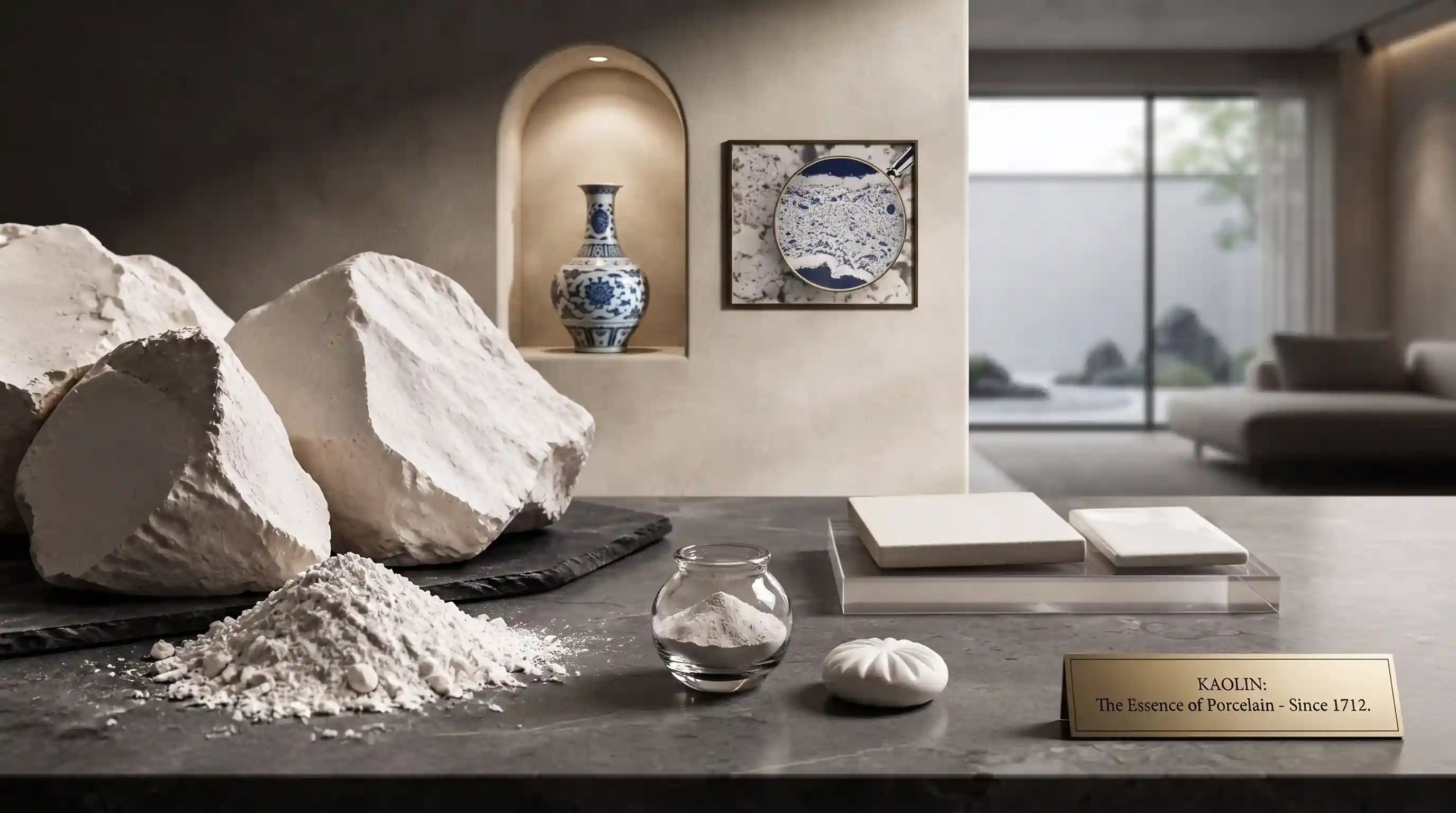
Application of Kaolin in Tile, Ceramic, and Glaze Industries
The ceramic and tile-making industry has long been the largest consumer of kaolin. This material acts as the main component in the manufacture of tile bodies, ceramic vessels, and industrial glazes. The suitable plasticity of this material in a wet state facilitates body formability and significantly increases the green strength of parts prior to the firing stage.
In the ceramic firing process, the presence of this material helps control the dimensional and firing changes of the product, preventing warping or cracking of parts. Additionally, this material is the primary source of alumina and silica in ceramic body formulations, creating a dense, durable, and long-lasting structure after firing. Uniform firing and improved mechanical strength are direct achievements of using this material.
In the glaze production sector, this material acts as a stabilizer that prevents suspended particles from settling in the glaze slip and improves its adhesion to the ceramic body. It also increases the transparency, gloss, and chemical resistance of the glaze after firing. Selecting the appropriate mesh in this field has a direct impact on the final surface quality of the glaze.
By offering high-quality and graded products, the Kani Sang Amiran collection covers the needs of tile and ceramic industry activists in the best possible way. Continuous cooperation with large production units demonstrates the importance of the stabilized quality of this mineral in improving firing and glazing processes.
The Role of Kaolin in Paper and Paint Manufacturing Industries
The paper manufacturing industry is another key consumer area for kaolin. In this industry, this material is used as a filler and surface coating. The use of this material fills the empty space between cellulose fibers, improves the surface smoothness of the paper, and consequently maximizes print quality, opacity, and paper whiteness.
This material also plays a prominent role in the paint and industrial coatings industries. To better understand this topic, reviewing an article about the role of kaolin in the production of advanced chemical catalysts alongside a specialized review of the application of kaolin in paint and industrial coating industries illuminates the broader dimensions of this material's applications. This material acts as a reinforcing pigment and filler, reducing the consumption rate of titanium dioxide.
Reducing titanium dioxide consumption due to its high price is of great economic importance for paint manufacturers, while no drop in quality occurs. Furthermore, this material improves peel resistance, moisture resistance, and corrosion resistance in industrial coatings, and adjusts the rheological properties of paint.
The micronized powder of this material, with proper particle distribution, increases the storage stability of the paint and prevents pigment settling. These advantages have caused paint and resin manufacturing factories to always seek the supply of this material with the highest standard of purity.

Processing, Micronization, and Quality Control of Kaolin
The production and processing process of kaolin requires advanced technologies to achieve a product with high purity and free from harmful impurities such as iron or magnesium oxides. Utilizing modern crushing and classification equipment, the Kani Sang Amiran project produces and supplies this mineral within the standard mesh range of 450 to 1500.
The micronization stage plays a very important role in determining the final properties of the powder. In this stage, mineral lumps are crushed under the influence of mechanical force and converted into particles on a micron scale. Precise control of particle size improves the specific surface area and increases the reactivity of the material in various industrial applications.
The collection's quality control laboratories examine all batches in terms of purity percentage, whiteness level, moisture, and particle size distribution. This rigorous monitoring ensures that the final product delivered to the customer maintains the stability of technical characteristics in the consumer's production line.
Compliance with national and international standards in the extraction and processing process has led to the trust of industrialists in this collection's products. Investment in the research and development sector has also significantly helped to continuously improve production methods and reduce impurities.
Economic and Industrial Advantages of Using Amiran Kaolin
Using high-quality domestic minerals has always been one of the main strategies for reducing import dependency and optimizing production costs. The kaolin produced by Kani Sang Amiran, with its competitive quality, is considered an ideal option for large and medium production units. Sustainable access to raw materials prevents production line stoppages.
In addition to economic benefits, improving the final properties of products such as paint, tile, paper, and ceramics creates high added value for manufacturers. When the final product has greater durability, a more beautiful appearance, and stable quality, it will capture a larger share of the consumer market.
Also, alongside this material, reviewing other industrial products such as the application of industrial barite in the production of sound and thermal insulation shows that the Kani Sang Amiran collection provides a complete portfolio of applicable minerals for various industries. This product diversity helps engineers find comprehensive solutions for their industrial projects.
Technical support and consultation regarding the selection of the appropriate mesh (between 450 and 1500 mesh) are other value-creating services provided to customers. This scientific approach greatly helps in the precise selection of materials and the enhancement of the qualitative level of national industries.
Safety, Maintenance, and Storage Tips for Kaolin
Like any other micronized mineral powder, observing safety tips and storage principles for kaolin is of special importance. Prolonged inhalation of mineral dust can cause problems for the respiratory system of workers; therefore, the use of personal protective equipment such as filtered masks and safety goggles in production environments and warehouses is mandatory.
The storage conditions of this material require a dry, indoor environment away from direct moisture. Due to their high specific surface area, micronized powders have a strong tendency to absorb ambient moisture, which can cause the product to lump and reduce its flowability in production lines. Palletizing the bags and maintaining a distance from the walls are key points of correct warehousing.
In case of leakage or scattering of powder in the working environment, wet cleaning methods or industrial vacuum cleaners equipped with HEPA filters should be used to prevent particles from becoming suspended in the air. Monitoring the health of packaging during transportation also prevents material waste.
Production and safety managers can provide a safe and efficient environment for personnel by developing precise guidelines. Compliance with safety standards not only guarantees the health of the workforce but also improves the overall efficiency of the workshop or factory.
Future Outlook and Expansion of Kaolin Applications in Industries
With the advancement of materials science and modern technologies, the outlook for using kaolin is expanding day by day. Researchers are constantly investigating new methods for surface modification of this material so that it can be used in advanced composites, plastics, rubber manufacturing, and nanotechnology.
Mineral producers like the Kani Sang Amiran project, by monitoring daily market needs and upgrading their micronization equipment, strive to offer more diverse products with more precise mesh sizing to the market. This adaptation to modern technologies guarantees survival and dynamism in today's competitive market.
The development of specialized applications of this material in catalysts, fire-retardant coatings, and industrial adsorbents indicates the high potential of this natural material. The future of the mineral industry belongs to companies that offer deeper processing and more controlled quality to their customers.
Finally, constructive interaction among research centers, mineral producers, and consuming industries will smooth the path of sustainable development and lead to greater self-sufficiency in supplying strategic industrial raw materials.

| Question |
Answer |
| What is kaolin and what are its applications? |
Kaolin is a hydrated aluminum silicate used in the tile, ceramic, glaze, paper, and paint industries. |
| What is the mesh size range of Amiran kaolin? |
This product is produced and supplied in the mesh range of 450 to 1500. |
| Is this material also used in the paint manufacturing industry? |
Yes, it is used as a filler and to reduce titanium dioxide consumption. |
| Where is the manufacturing group of this mineral located? |
The Kani Sang Amiran project is the specialized producer of these minerals. |
| Why is high mesh sizing important in kaolin? |
Higher mesh means finer particles, greater specific surface area, and improved final quality in paint and ceramics. |
| What is the role of kaolin in the paper manufacturing industry? |
It is used as a filler and coating agent to increase the whiteness and surface smoothness of paper. |
| How should this material be stored? |
It should be stored in a dry, indoor environment away from direct moisture and on pallets. |
| Does this product affect ceramic production? |
Yes, it increases body plasticity in a wet state and makes firing uniform. |
| How can this product be obtained? |
It can be ordered through the dedicated product page on the Kani Sang Amiran website. |
| Are there other related links on the site? |
Yes, articles about catalysts, paint manufacturing, and barite are available on the site. |
Specialized reference for mineral and industrial materials Kani Sang Amiran (ksamiran.ir)
:: برچسبها:
Kaolin ,
Application of Kaolin in the Production of Agricultural Fertilizers and Pesticides ,
:: بازدید از این مطلب : 0
|
امتیاز مطلب : 0
|
تعداد امتیازدهندگان : 0
|
مجموع امتیاز : 0


 عضو شوید
 عضویت سریع
 آمار مطالب
 آمار بازدید


