
The Impact of White Talc on Reducing Mineral Production Costs
An Introduction to the Role of Minerals in Optimizing Production Costs
In modern industries, managing production costs is one of the most significant challenges for industrial managers. Choosing high-quality yet cost-effective raw materials can have a profound impact on the ultimate profitability of manufacturing complexes. Meanwhile, the use of functional minerals as fillers and improvers of physical and mechanical properties has gained a special position. The Kani Sang Amiran project, focusing on the supply and processing of high-grade minerals, provides innovative solutions for various industries to increase production line efficiency.
One of the most prominent of these materials is white talc, which is known as a multi-purpose material due to its unique structural and chemical properties. With its layered structure and specific softness, this mineral can serve as a suitable replacement for many expensive additives in industrial formulations. A thorough examination of the applications and technical advantages of this material paves the way for reducing overhead costs and increasing final product quality.
Reducing production costs does not simply mean purchasing cheap materials; it also encompasses optimizing energy consumption, reducing production waste, improving process speed, and extending the lifespan of parts and products. In the continuation of this article, we will examine the various dimensions of how using this micronized mineral powder improves the economic and technical indices of different industries, drawing a clear roadmap for industrial units.
Getting to Know White Talc and Its Technical Specifications in the 450 to 2500 Mesh Range
Talc is a hydrated magnesium silicate extracted naturally from mines and prepared for industrial consumption after undergoing crushing, milling, and precise grading processes. One of the key parameters determining the quality and efficiency of this material is its degree of purity and mesh size range. The products offered in the 450 to 2500 mesh range cover a wide spectrum of particle sizes, making them highly ideal for specialized applications.
Finer mesh sizes (such as higher meshes up to 2500) indicate very small, micron-sized dimensions that create uniform distribution within a polymer matrix, paint, or paper. This characteristic increases the material's surface area, thereby improving mechanical and appearance properties. For more information regarding specialized features, you can visit the dedicated white talc page, which provides the complete specifications of this product.
In addition to particle dimensions, high whiteness, chemical inertness, heat resistance, and excellent flow properties are other prominent traits of this material. Careful processing of this mineral rock in specialized facilities ensures that completely homogeneous particles free of disruptive impurities reach the final consumer, directly contributing to the quality stability of industrial products.
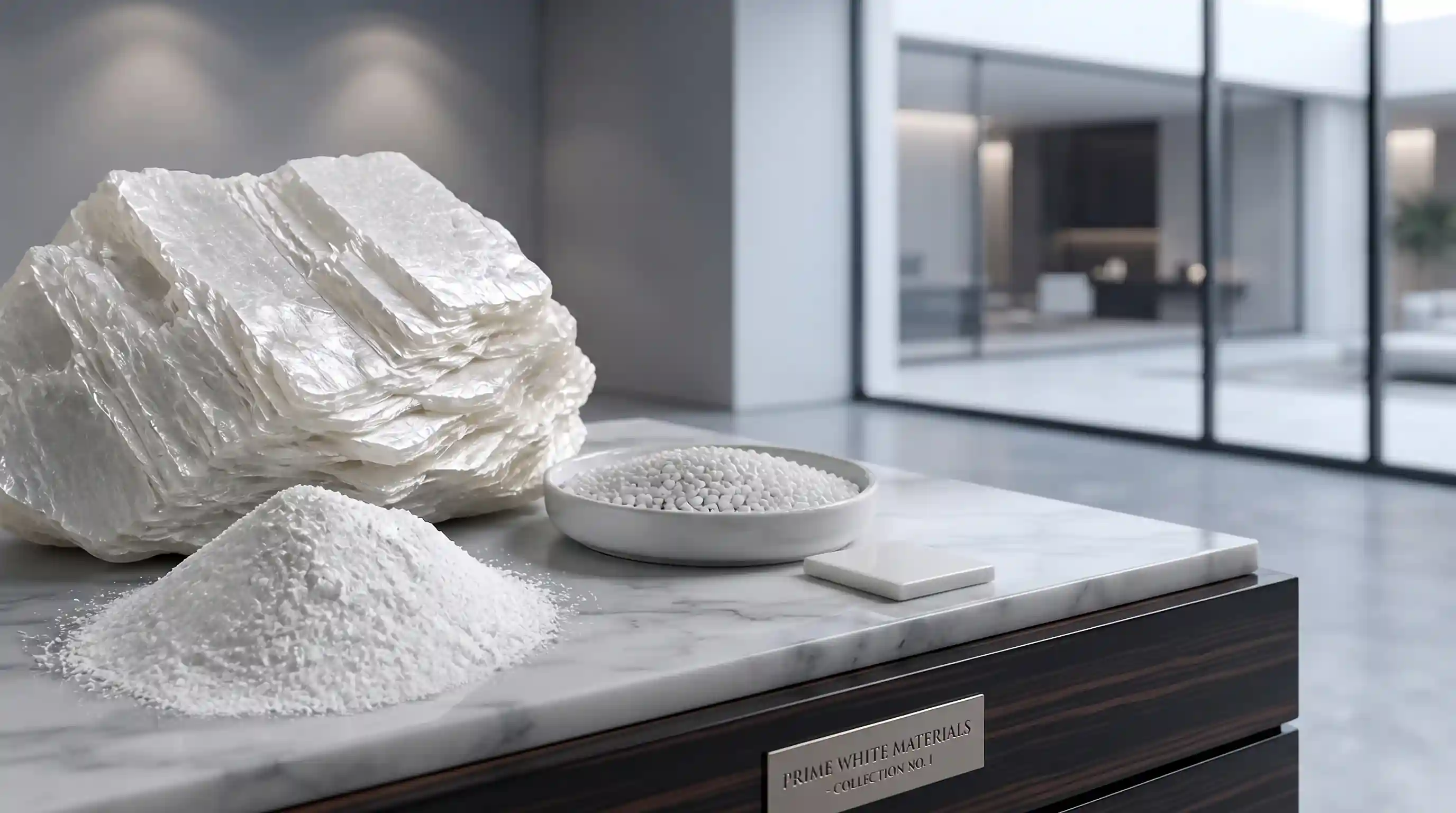
Application of White Talc in Masterbatch and Compound Industries and Its Impact on Final Price
The plastics, polymer, masterbatch, and compound manufacturing industries are constantly seeking additives that reduce the final product price while maintaining or enhancing mechanical properties. In this context, using high-grade mineral powder as a filler is very common. Due to its proper compatibility with various polymers, this material disperses well within polymer blends.
Adding this mineral to masterbatch and compound formulations increases whiteness, improves dimensional stability, enhances rigidity, and reduces shrinkage in plastic parts. Since the prices of base polymer raw materials are typically high, replacing a portion of them with standard mineral powders has a substantial impact on reducing raw material costs. For further reading regarding valuation and economic analyses, studying the article Examination of White Talc Price and Factors Affecting Its Valuation is recommended.
Furthermore, the improvement of melt flow properties during extrusion and plastic injection processes thanks to the presence of this material optimizes machine energy consumption and reduces equipment depreciation. These combined benefits allow masterbatch and compound production units to confidently use this material in their mass production lines.
The Role of White Talc in the Paint Manufacturing and Industrial Coatings Industries
In the paint and coatings industry, achieving optimal coverage, brilliant whiteness, and long-term durability are primary formulation goals. The use of appropriate mineral pigments and fillers plays a decisive role in the final quality of paint. Because of its suitable refractive index and layered structure, this micronized powder is recognized as an outstanding functional filler in various water-based and oil-based paints.
The presence of this material in paint formulations improves settling properties, increases resistance to peeling, enhances adhesion, and boosts the durability of the paint film against weather elements. Additionally, the flaky structure of the particles prevents moisture and gases from penetrating the underlying surface, which heavily reinforces the paint's anti-corrosive property. Alongside this material, some industries utilize other minerals for specific thermal and acoustic applications, and exploring those dimensions in the article Application of Industrial Barite in the Production of Acoustic and Thermal Insulations is well worth a read.
From an economic perspective, using this material as a replacement for a portion of titanium dioxide (which is an expensive material) helps dramatically reduce paint production costs without causing a noticeable drop in whiteness and covering power. This significantly increases the profitability of paint manufacturers.

Improving Quality and Reducing Costs in the Papermaking Industry with White Talc
The papermaking industry is a major consumer of minerals as fillers and coating agents. Characteristics such as whiteness, softness, non-abrasive nature, and high ink absorption capacity make this mineral an exceptional choice for producing various types of paper and cardboard. This micronized powder easily distributes within the paper pulp and fills the empty spaces between cellulosic fibers.
Using this material in papermaking significantly helps improve opacity, surface smoothness, printability, and reduces light transmission. On the other hand, because the final cost of this material is much lower than pure cellulosic fibers, replacing a percentage of wood pulp with this mineral filler has a direct impact on reducing the final costs of paper production.
Moreover, the lubricating properties of this material reduce friction in papermaking machinery and increase production line efficiency. These features, combined with stable supply from reliable domestic sources, enable paper mills to offer high-quality, competitive products to the market.
Application in the Ceramic Industry and Tile and Porcelain Products
In the ceramics manufacturing industry, securing raw materials that remain stable at high firing temperatures and do not deform is of vital importance. This mineral is utilized as a key component in the bodies and glazes of ceramic products, tiles, and porcelain dishes. The presence of magnesium and silica within this material's composition helps improve firing properties and increases the mechanical strength of ceramic pieces.
The micronized particles of this material act as an opacifying and whiteness-improving agent in ceramic glazes, creating a smooth and flawless surface. In addition, reducing the coefficient of thermal expansion of the ceramic body prevents glaze cracking during the cooling stages, which minimizes production waste.
Reducing waste and improving the efficiency of firing kilns directly lowers ceramic production costs. By utilizing appropriate mesh sizes of this material, manufacturers can achieve more optimized formulations that are fully justified both in terms of technical quality and economy.

Technical and Economic Advantages of Using Various Meshes (450 to 2500)
Choosing the correct mesh for each industrial application is the key to achieving maximum efficiency and lowest cost. Lower meshes (such as 450) are typically used in industries requiring volumetric mechanical properties and simpler filling, whereas high meshes (up to 2500) are essential for thin coatings, high-quality paints, and sensitive polymer compounds.
Technical evaluations show that the narrower the particle size distribution and the finer the particles, the more uniform the dispersion in the product matrix becomes, preventing particle agglomeration. For a deeper understanding of these specialized benefits, reading the article Examination of Technical Benefits of Using Micronized White Talc will serve as a very comprehensive guide for engineers and production managers.
From an economic standpoint, using the appropriate mesh prevents material waste and guarantees final quality. By offering diverse products within this mesh-sizing range, the Kani Sang Amiran project leaves manufacturers free to choose the most precise option so they can strike an unmatched balance between quality and price.
Conclusion and Future Prospects of Optimal Mineral Supply in Industry
In this article, we comprehensively reviewed the role and impact of this valuable mineral on reducing production costs in key industries such as masterbatch, compounds, paints, paper, and ceramics. It became clear that the inherent characteristics of this mineral powder make it a smart, economical alternative to many expensive additives. Proper cost management alongside product quality enhancement is the secret to survival and success in today's competitive markets.
Relying on principled extraction, advanced processing, and strict quality control, the Kani Sang Amiran project supplies high-quality micronized powders in the 450 to 2500 mesh range to best cover the diverse needs of the country's industries. A smart choice of raw materials counts as a secure investment for the future of manufacturing units.
With the development of modern technologies and industries' growing need for eco-friendly, low-cost raw materials, the use of natural mineral fillers will follow an upward trend. By collaborating with reputable suppliers, industrialists and manufacturers can take a giant step toward optimizing production processes, increasing efficiency, and drastically cutting final costs.

| Question |
Answer |
| What is white talc and what are its applications? |
It is a natural hydrated magnesium silicate used as a filler and property enhancer in masterbatch, compound, paint, paper, and ceramic industries. |
| What is the mesh range of the supplied products? |
These products are processed and supplied in the 450 to 2500 mesh range with the highest quality. |
| How does using this material reduce production costs? |
By replacing a portion of expensive raw materials such as polymers, titanium dioxide, or wood pulp and improving production process efficiency. |
| Is this material used in the plastics and polymer industries? |
Yes, it is widely used in masterbatch and compound production to improve whiteness, rigidity, and dimensional stability. |
| What is the role of this material in the paint manufacturing industry? |
Improving coverage, increasing resistance to moisture and corrosion, and reducing the consumption of expensive pigments. |
| Why is mesh sizing important in the performance of this material? |
Finer mesh sizing creates a more uniform distribution and better mechanical and appearance properties in the final product. |
| Is this material also used in the papermaking industry? |
Yes, it is employed as a filler to increase whiteness, surface smoothness, and paper printability. |
| What is the application of this material in ceramics? |
Improving firing, increasing body strength, and controlling the coefficient of thermal expansion in tiles and ceramics. |
| How can one obtain more technical information? |
By visiting the dedicated product page on the Kani Sang Amiran website or reading related specialized articles. |
| How can one proceed to purchase this product? |
By contacting the sales department of the Kani Sang Amiran project and reviewing the technical specifications listed on the site. |
Kani Sang Amiran Project — Reference for Supply and Specialized Processing of Industrial Minerals
:: برچسبها:
White Talc ,
The Impact of White Talc on Reducing Mineral Production Costs ,
:: بازدید از این مطلب : 4
|
امتیاز مطلب : 0
|
تعداد امتیازدهندگان : 0
|
مجموع امتیاز : 0


 عضو شوید
 عضویت سریع
 آمار مطالب
 آمار بازدید


