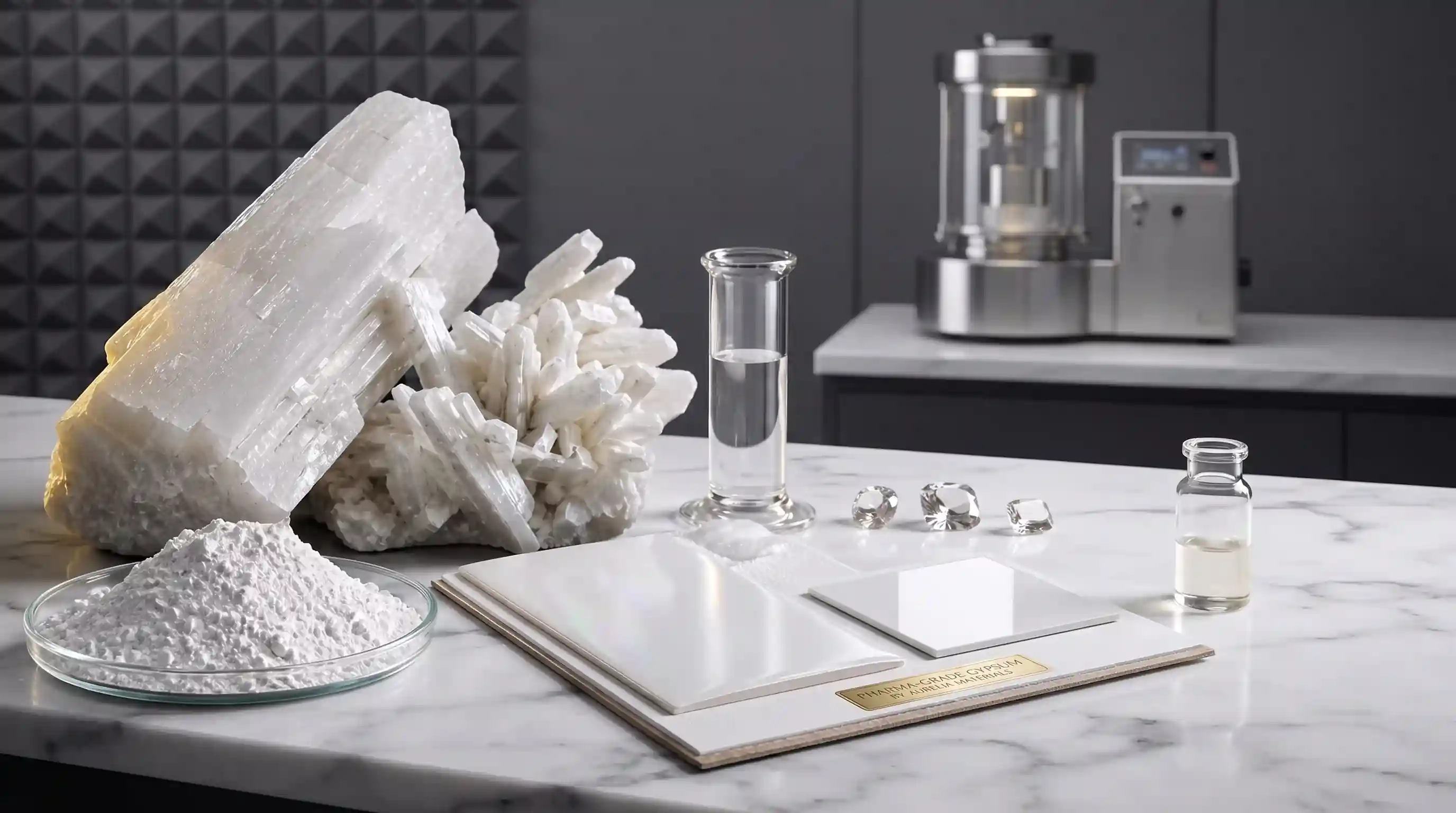
The Strategic Role of White Barite in the Production of Thermal and Acoustic Insulation
Introduction to the Importance of Mining and the Application of White Barite in Modern Industries
Today's modern industries are more dependent than ever on high-quality and specialized mineral materials. In this regard, processed minerals play a key role in enhancing the quality of final products. Among various mineral fillers, white barite is recognized as one of the most valuable mineral compounds which, due to its unique physical and chemical properties, has found a special place in various industries. The Kani Sang Amiran project, focusing on the production and supply of standard mineral materials, has managed to meet the needs of advanced industries for this vital material.
The appearance characteristics and high purity of this mineral have made it suitable for precise industrial formulations. Since the paint, coatings, and polymer industries require fillers with precise particle size distribution and a neutral color, the use of this mineral has become a necessity. In this article, we intend to closely examine the strategic role of this material in various industries and analyze the different dimensions of its application.
Accurate understanding of the technical characteristics of minerals helps engineers and industrial designers produce more efficient products. To better understand this topic, reviewing the application areas of this material and comparing it with other fillers is of utmost importance. Further in the discussion, more details regarding the physical properties and various mesh sizes of this material will be provided to shed more light on the hidden aspects of its importance in industry.
Sustainable development in manufacturing industries requires the use of high-quality domestic mineral resources. White barite, with its high density and suitable chemical purity, not only helps improve the mechanical properties of products but also plays a significant role in optimizing production costs. In the following sections, we will take a more specialized look at its mesh characteristics and applications.
Technical Features and Physical Specifications of White Barite
Understanding the technical specifications of base minerals is the first step in industrial product formulation engineering. White barite is known for its specific properties such as high density, excellent chemical stability, and low oil absorption coefficient. This material acts as an efficient mineral filler in various industries and, due to its bright white color, has the least negative impact on the final color of the product.
One of the most important parameters in selecting this material is its mesh range. This product is produced and supplied in the mesh range of 450 to 2500, which indicates the high precision in its micronization process. Fine and uniform granulation within this wide range helps particles to disperse completely homogeneously within the base material matrix and noticeably improve the physical and mechanical properties of the final product.
Proper particle dispersion in high mesh ranges increases abrasion resistance, improves rheological properties, and reduces dimensional changes in polymer products and paints. Also, the high purity of this mineral prevents unwanted chemical reactions in complex formulations and ensures the long-term stability of products.
Engineers and industrial formulators are always looking for fillers that, in addition to reducing the final cost, also enhance the final quality. With the aforementioned features, this mineral accurately responds to these needs and is recognized as a quality standard in many production lines.

The Key Role of White Barite in the Paint and Industrial Coatings Industry
The paint and coating industry is a major consumer of micronized minerals. White barite is introduced for paint, coatings, and polymer products containing mineral fillers and is widely used as a filler and performance-improving agent in this industry. The presence of this material in paint formulations significantly helps increase coverage, improve weather resistance, and increase density.
Using this material in architectural and industrial paints reduces the consumption of titanium dioxide (as an expensive pigment) without compromising the optical quality of the paint. Due to its suitable refractive index, this material helps better light scattering and increases the gloss of final coatings. In addition, its high chemical resistance ensures better surface protection against corrosive environmental factors.
In the field of specialized coatings, the thermal and acoustic stability of this material is also of great importance. Coatings containing this mineral filler can act as effective barriers against sound and heat transfer, which is closely related to the topics discussed in the article Application of Industrial Barite in the Production of Acoustic and Thermal Insulation and completes its engineering dimensions.
Precise paint formulation using white barite leads to the production of products with appropriate viscosity, high storage stability, and better application properties. These advantages have led major paint and coating manufacturers to always include this material in their raw material procurement basket.
Application of White Barite in Polymer Products and Plastics
The polymer industry and plastic manufacturing require mineral fillers that are well compatible with the polymer matrix. White barite is recognized as an efficient mineral filler in these products and has secured a strong foothold in the plastics, rubber, and polymer composites industries. Adding this material to polymers helps improve the modulus of elasticity, increase hardness, and enhance the dimensional stability of manufactured parts.
Particle size distribution in the 450 to 2500 mesh range plays a vital role in improving the mechanical properties of polymers. Micronized particles easily distribute in the molten polymer and prevent particle agglomeration. This structural homogeneity increases the impact and tensile strength of polymer products and maximizes the performance of parts in engineering applications.
In addition to polymers, comparing the performance of various minerals in the plastics and pipe manufacturing industries has always been of interest to researchers. For example, examining the effects of other fillers such as The Role of Calcium Carbonate in Plastic Pipe Manufacturing provides a comprehensive view of the mechanical behavior of fillers in different polymer matrices and helps in more optimal material selection.
Finally, using this material in polymer composites reduces the mold shrinkage rate, improves the surface appearance of parts, and lowers the final production costs without sacrificing technical quality, which increases the profitability of manufacturing units.

Improving Acoustic and Thermal Insulation Properties Using Mineral Fillers
One of the major challenges in building engineering and the automotive industry is controlling sound and heat transfer. Due to its high density and compact particle structure, white barite plays a very effective role in upgrading the performance of acoustic and thermal insulation. When this mineral is used as a filler in insulation structures, it increases the bulk density of the material and consequently drastically reduces the transmission coefficient of sound waves.
In the field of thermal insulation, the presence of particles of this material helps structural stability against high temperatures and prevents the degradation of coating quality under critical conditions. These features make products containing this mineral reliable engineering solutions in the oil, gas, petrochemical, and advanced construction industries.
The right choice of mesh size (from 450 to 2500 mesh) allows for product customization based on the exact requirements of the project. Finer particles reduce permeability and create greater continuity in the insulation layer, which in turn maximizes the system's efficiency in containing unwanted energy and noise.
By providing standard products in this field, the Kani Sang Amiran project has provided engineers with the necessary tools to design and manufacture insulation with the highest quality and performance standards, and to comply with environmental and acoustic standards in the best possible way.
Production Process, Micronization, and Quality Control of White Barite
The final quality of minerals is directly dependent on their extraction, processing, and micronization processes. The production of white barite requires advanced crushing and classification equipment to achieve a uniform product that complies with strict industrial standards. The mesh range of 450 to 2500 demonstrates technical capability in precise control of particle dimensions during production stages.
Quality control at all stages of production, from initial mining to final packaging, is of particular importance. Quality control laboratories use modern equipment such as laser particle size analyzers to continuously measure chemical purity, whiteness level, and particle size distribution to ensure that a flawless product reaches the consumer.
This precision in the production process allows consumer industries to standardize their formulations without worrying about quality fluctuations. Consistency in color, density, and mesh distribution is a prominent feature of the products supplied by the Kani Sang Amiran project, which has earned the trust of advanced industries.
Optimizing energy consumption and using modern milling technologies also play a role in reducing production costs and preserving the environment. Principled processing of this mineral creates high added value and guides the country's mineral economy toward sustainable development.

Comparison of White Barite with Other Mineral Fillers in Specialized Industries
In formulation engineering, choosing the right mineral filler is always a trade-off between cost, performance, and physical characteristics. Due to its high density and chemical purity, white barite has significant competitive advantages over traditional fillers such as calcium carbonate, talc, or silica. While other fillers may have lower stability against acids or high temperatures, this material exhibits unparalleled stability.
One of the main differences is the high density of barite, which makes it an unrivaled option for applications requiring heaviness and sound shielding. In contrast, lighter fillers may not have the necessary efficiency in specific applications. Furthermore, the chemical inertness of this material makes it compatible with a wide range of resins, polymers, and additives.
Industrial reviews show that the intelligent combination of different fillers sometimes yields the best results. For example, the technical knowledge gained from the application of other minerals in purification or plastic manufacturing, such as the experience gained in the field of The Role of Bentonite in Water and Industrial Wastewater Treatment, helps engineers adopt a holistic approach toward the selection and application of minerals in various industries.
Ultimately, decision-making regarding the choice of mineral filler type depends on the technical criteria of the project. However, given the unique properties of white barite, this material is always recognized as the first choice in the paint, coating, and polymer industries.
Market Outlook, Sustainability, and Key Points in Selecting White Barite
The global market for filler minerals is moving toward a demand for high-purity products with more precise mesh sizing. As a strategic mineral, white barite plays a prominent role in the development of high-quality, eco-friendly industrial products. Complying with quality standards and meeting the growing needs of industries is the key to success in this field.
Leveraging rich resources and advanced processing technologies, the Kani Sang Amiran project strives to supply the best mesh sizes ranging from 450 to 2500 mesh to the market. This continuity in supply provides peace of mind for manufacturers and prevents production line shutdowns.
When selecting and purchasing this product, paying attention to parameters such as purity percentage, whiteness level, mesh distribution, and packaging type is of great importance. Consulting with technical experts and carefully reviewing the product's Technical Data Sheet (TDS) helps establish the best match between the mineral and the formulation requirements.
Looking to the future indicates that the development of advanced formulations in insulation, polymer, and coating industries will not be possible without the use of high-quality micronized mineral fillers. Therefore, investing in the supply of standard raw materials like white barite will guarantee the quality and competitiveness of products in domestic and international markets.

| Question |
Answer |
| What is white barite and what are its applications? |
White barite is a high-quality mineral filler primarily used in the paint, coating, and polymer product industries. |
| What is the mesh range of the white barite produced by Kani Sang Amiran? |
This product is produced and supplied in the mesh range of 450 to 2500. |
| Why is white barite used in the paint industry? |
Due to increased coverage, improved optical stability, reduced titanium dioxide consumption, and enhanced physical properties of the paint. |
| What is the role of white barite in acoustic and thermal insulation? |
Due to its high density and fine granulation, it reduces the transmission of sound waves and improves the thermal stability of the insulation. |
| How can this product be procured? |
You can visit the dedicated product page on the Kani Sang Amiran project website. |
| Is white barite also used in polymer industries? |
Yes, it is used as a mineral filler in polymer products to increase hardness and improve dimensional stability. |
| What is the advantage of white barite over other fillers? |
High density, excellent chemical purity, inertness, and high stability under harsh environmental conditions. |
| Does the mesh size range affect the properties of the final product? |
Yes, uniform particle distribution at high meshes results in better dispersion within the matrix and enhances mechanical properties. |
| What services does the Kani Sang Amiran project offer? |
Production and supply of standard and specialized minerals for various industries across the country. |
| Can this material be used in specialized coatings? |
Yes, this material is used as a key filler in various industrial and protective coatings. |
Specialized Mineral and Industrial Materials Reference of Kani Sang Amiran Project (ksamiran.ir)
:: برچسبها:
White Barite ,
The Strategic Role of White Barite in the Production of Thermal and Acoustic Insulation ,
:: بازدید از این مطلب : 0
|
امتیاز مطلب : 0
|
تعداد امتیازدهندگان : 0
|
مجموع امتیاز : 0


 عضو شوید
 عضویت سریع
 آمار مطالب
 آمار بازدید


